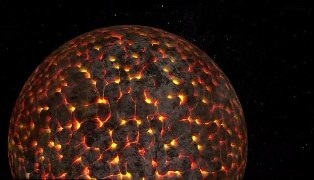


HARROW: The moon was once home to spectacular ‘fire fountains’, similar to those seen in Hawaii today.
The Apollo missions found remnants of these lava fountains in tiny beads of volcanic glass on the moon.
Now, US scientists believe they have identified the volatile gas that drove those eruptions, finally solving the mystery to how they formed.
Fire fountains, a type of eruption that occurs frequently in Hawaii, require the presence of volatiles mixed in with the erupting lava.
Volatile compounds turn into gas as the lavas rise from the depths.
That expansion of that gas causes lava to blast into the air once it reaches the surface, a bit like taking the lid off a shaken bottle of Pepsi.
‘The question for many years was what gas produced these sorts of eruptions on the moon,’ said Alberto Saal, associate professor of Earth, environmental, and planetary sciences.
‘The gas is gone, so it hasn’t been easy to figure out.’
The research, published in Nature Geoscience, suggests that lava associated with lunar fire fountains contained significant amounts of carbon.

Karachi Port sets 138-year cargo handling record
KARACHI: Pakistan's maritime sector has achieved a major milestone as Karachi Port set a new record in its 138-year history...