Customs Today
  • Home
  • Islamabad
  • Karachi
  • Lahore
  • National
  • Transfers and Postings
  • Chambers & Associations
  • Business
No Result
View All Result
Customs Today
  • Home
  • Islamabad
  • Karachi
  • Lahore
  • National
  • Transfers and Postings
  • Chambers & Associations
  • Business
No Result
View All Result
Customs Today
No Result
View All Result
Home Science & Technology Science

Scientists discovered nearly 2,000 exoplanets around the universe

byCustoms Today Report
07/11/2015
in Science, Science & Technology
Share on FacebookShare on Twitter

BRENT: There are the planets we know about — Earth, Mars, Venus, Jupiter, Neptune, Mercury, Uranus and Saturn — and the exoplanets well beyond our solar system that we’re trying to learn more about.

In fact, scientists have discovered nearly 2,000 exoplanets around the universe, and that number is only expected to rise with time. Earlier this week, NASA even released a mini-documentary about the search for exoplanets, which could possibly lead to the discovery of extraterrestrial life, if such a thing exists.


You might also like

Tesla driverless system to use updated radar technology

12/09/2016

Apple to develop its own self-driving technology

10/09/2016

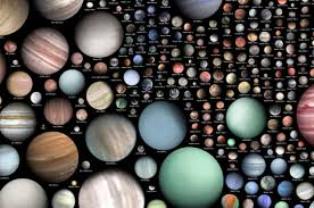
All this being said, one creative 17-year-old designer, Martin Vargic, took to the Internet to visualize and share what hundreds of exoplanets might look like in space via an infographic. The result is a beautiful collage of 500 extra worlds that is getting people talking around the Web, as spotted by Fast Company Design.

“I based the looks of each planet chiefly on its estimated radius and temperature, however, other factors, such as density, age or stellar metallicity were also taken into consideration,” Vargic told Fast Co. Design. “The colors of gas giant planets were chosen to be as realistic as possible, reflecting the different cloud compositions of hotter gas giants.”

As Vargic alluded to, the exoplanets are arranged by average temperature on the X-axis and by mass density on the Y-axis in this infographic.

Even though there’s a lot to see within this infographic, Fast Co. Design points out that it only represents about 25 percent of all known exoplanets, meaning it won’t remain fresh for long. Still, it’s a sight to see, especially when zoomed out in all its glory.


Related Stories

Tesla driverless system to use updated radar technology

byCT Report
12/09/2016

WASHINGTON: Electric carmaker Tesla announced Sunday it was upgrading its Autopilot software to use more advanced radar technology. In a...

Apple to develop its own self-driving technology

byCT Report
10/09/2016

SAN FRANCISCO: Apple may not become an automaker, but it still wants to develop its own self-driving technology. The iPhone-maker's...

NASA spots slowest known magnetar

byCT Report
10/09/2016

WASHINGTON: Astronomers have found evidence of a magnetar - magnetised neutron star - that spins much slower than the slowest...

‘YouTubers’ outshining old-school television

byCT Report
09/08/2016

SAN FRANCISCO: A media revolution is taking place, and most people over 35 years of age aren’t tuned in. Millennial...

Next Post

Customs arrests woman in tourist death case

  • Terms and Conditions
  • Disclaimer

© 2011 Customs Today -World's first newspaper on customs. Customs Today.

No Result
View All Result
  • Transfers and Postings
  • Latest News
  • Karachi
  • Islamabad
  • Lahore
  • National
  • Chambers & Associations
  • Business
  • About Us

© 2011 Customs Today -World's first newspaper on customs. Customs Today.