

Customs Today
  • Home
  • Islamabad
  • Karachi
  • Lahore
  • National
  • Transfers and Postings
  • Chambers & Associations
  • Business
No Result
View All Result
Customs Today
  • Home
  • Islamabad
  • Karachi
  • Lahore
  • National
  • Transfers and Postings
  • Chambers & Associations
  • Business
No Result
View All Result
Customs Today
No Result
View All Result
Home Science & Technology Science

Scientists finally know how sea sapphires can ‘disappear’

byCustoms Today Report
25/07/2015
in Science, Science & Technology
Share on FacebookShare on Twitter

You might also like

Tesla driverless system to use updated radar technology

12/09/2016

Apple to develop its own self-driving technology

10/09/2016

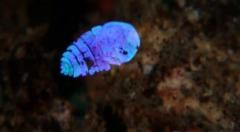
NEW YORK: Sea sapphires live by a “now you see ’em, now you don’t” mantra. But when they do make an appearance, they’re the crown jewel of the undersea world.
The iridescent creatures — scientifically known as Sapphirina copepods — can appear in hues ranging from fluorescent blue, like the little guy above, to bright gold. Researchers have long wondered how the copepods pull off the Houdini act, in which they go from bright, leaf-shaped swimmers one moment before a quick turn renders them nearly invisible.
But members of Israel’s Weizmann Institute of Science have finally discovered the secret: “alternating layers of hexagonal-shaped guanine crystals and cytoplasm,” according to a study they published last month in the Journal of the American Chemical Society.
In layman’s terms, this means the copepods have honeycomb-shaped layers of fluid-filled “crystals,” which also contribute to the sheen seen on fish scales. When the sea sapphires move, the angle of light produces a colorful reflective effect, with different-sized crystal layers in different species resulting in a variety of hues.
As New Scientist notes, the sea sapphire in the video above seems to disappear when it tilts to an angle of 45 degrees away from the sun. This causes the reflected light to “slip into the ultraviolet spectrum,” which is invisible to humans.

Related Stories

Tesla driverless system to use updated radar technology

byCT Report
12/09/2016

WASHINGTON: Electric carmaker Tesla announced Sunday it was upgrading its Autopilot software to use more advanced radar technology. In a...

Apple to develop its own self-driving technology

byCT Report
10/09/2016

SAN FRANCISCO: Apple may not become an automaker, but it still wants to develop its own self-driving technology. The iPhone-maker's...

NASA spots slowest known magnetar

byCT Report
10/09/2016

WASHINGTON: Astronomers have found evidence of a magnetar - magnetised neutron star - that spins much slower than the slowest...

‘YouTubers’ outshining old-school television

byCT Report
09/08/2016

SAN FRANCISCO: A media revolution is taking place, and most people over 35 years of age aren’t tuned in. Millennial...

Next Post

Honda wraps off new 2016 Honda Accord in America

  • Terms and Conditions
  • Disclaimer

© 2011 Customs Today -World's first newspaper on customs. Customs Today.

No Result
View All Result
  • Transfers and Postings
  • Latest News
  • Karachi
  • Islamabad
  • Lahore
  • National
  • Chambers & Associations
  • Business
  • About Us

© 2011 Customs Today -World's first newspaper on customs. Customs Today.