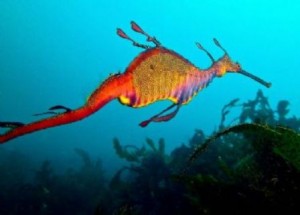


HARROW: There’s another color of seadragon out there: deep ruby red. Scientists had previously believed there were only two seadragon species, and thus just two color variations — the orange hues of the leafy seadragon (Phycodurus eques) and the purple-accented yellows of the weedy seadragon (Phyllopteryx taeniolatus).
Recently, while analyzing tissue samples taken from seadragon specimens collected in southern Australia in 2007, scientists noticed something askew. Researchers with the Scripps Institution of Oceanography at the University of California, San Diego, identified a genetic anomaly.
When they looked at the seadragon whose DNA sequence didn’t quite match up with the rest, they saw the fish’s genetic uniqueness was matched by its distinctive red pigmentation.
“We’re now in a golden age of taxonomy and these powerful DNA tools are making it possible for more new species than ever to be discovered,” Greg Rouse, curator of the Scripps Benthic Invertebrate Collection, explained in a press release.
Seadragons look like longer, larger versions of seahorses. But the fish and their intricate protruding fins are delicate and rare, found only among the coral of southern Australia.
“That such large charismatic marine species are still being found is evidence that there is still much to be done,” Rouse added. “This latest finding provides further proof of the value of scientific collections and museum holdings.”Advanced imaging allowed scientists to study the anatomy of the red seadragon and confirm their genetic findings.

Karachi Port sets 138-year cargo handling record
KARACHI: Pakistan's maritime sector has achieved a major milestone as Karachi Port set a new record in its 138-year history...