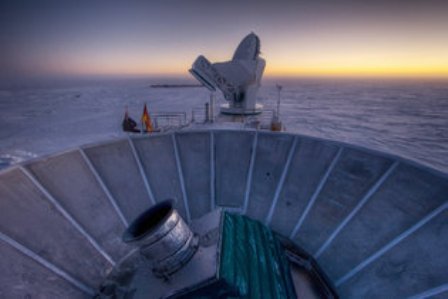
LONDON: Last spring, a team of astronomers who go by the name of Bicep announced that they had detected ripples in space-time, or gravitational waves, reverberating from the first trillionth of a trillionth of a trillionth of a second of time — long-sought evidence that the expansion of the universe had started out with a giant whoosh called inflation.
The discovery was heralded as potentially the greatest of the new century, but after months of spirited debate, the group conceded that the result could have been caused by interstellar dust, a notion buttressed by subsequent measurements by the European Space Agency’s Planck satellite that the part of the sky Bicep examined was in fact dusty.


Now a new analysis, undertaken jointly by the Bicep group and the Planck group, has confirmed that the Bicep signal was mostly, if not all, stardust, and that there is no convincing evidence of the gravitational waves. No evidence of inflation.
“This analysis shows that the amount of gravitational waves can probably be no more than about half the observed signal,” Clem Pryke of the University of Minnesota said Friday in an interview.
“We can’t say with any certainty whether any gravity wave signals remain,” Dr. Pryke added. “Obviously, we’re not exactly thrilled, but we are scientists and our job is to try and uncover the truth. In the scientific process, the truth will emerge.”
When the galactic dust is correctly subtracted, the scientists said, there was indeed a small excess signal — a glimmer of hope for inflation fans? — but it was too small to tell if it was because of gravitational waves or just experimental noise.