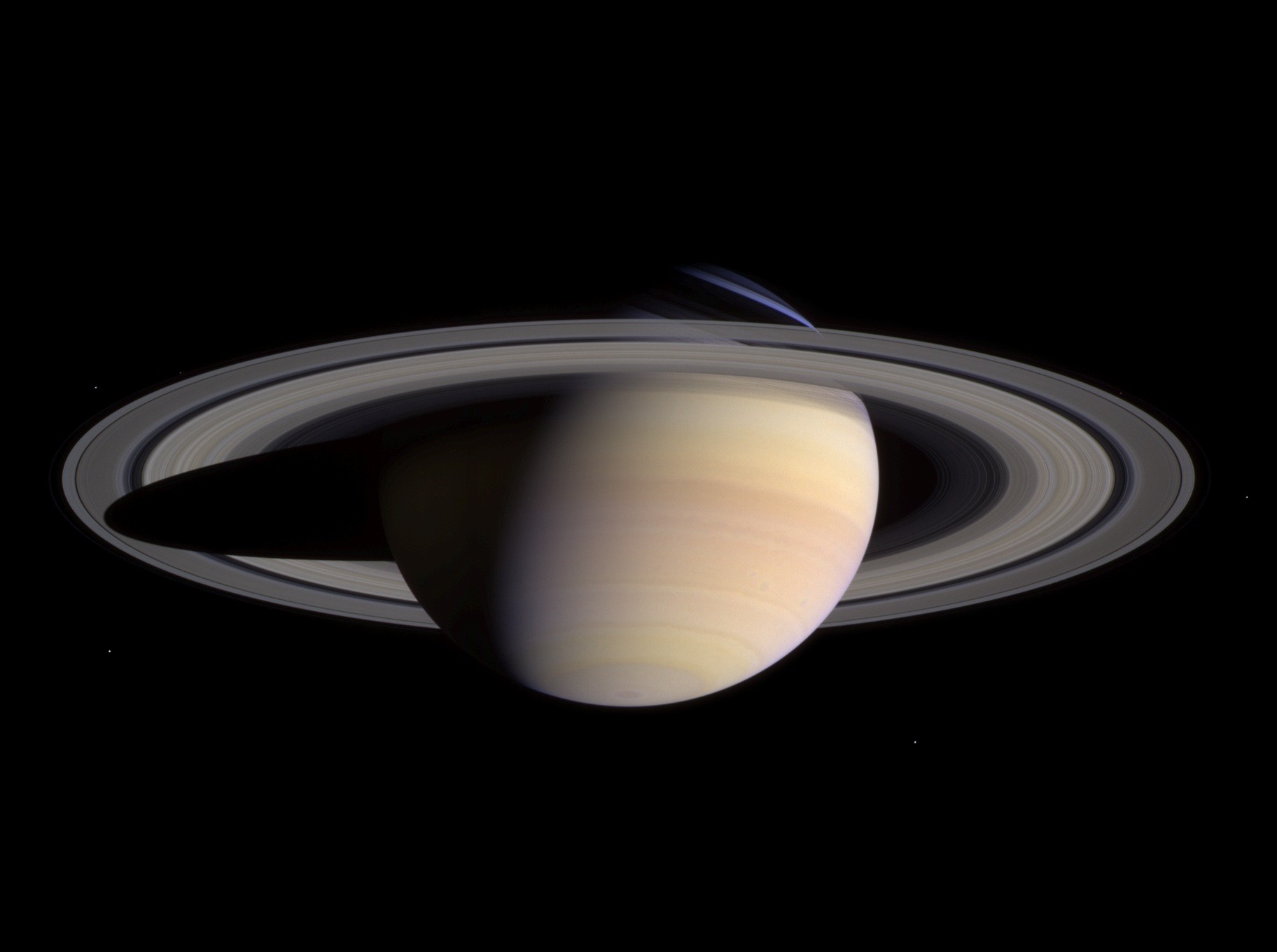

EFANCE: Scientists have paired NASA’s Cassini spacecraft with the National Science Foundation’s Very Long Baseline Array (VLBA) radio-telescope system to pinpoint the position of Saturn and its family of moons to within about 2 miles (4 kilometres). The measurement is some 50 times more precise than those provided by ground-based optical telescopes. The feat improves astronomers’ knowledge of Saturn’s orbit and benefits spacecraft navigation and basic physics research.
Presenting the findings at the meeting of the American Astronomical Society in Seattle, scientists explained that they have been able to calculate the distance to Saturn in ways that are more accurate than previous estimations.
The Cassini space probe was set off in 1997 and it arrived Saturn seven years later – and it’s been orbiting Saturn since 2004 – singing signals that are picked up by the VLBA telescope. “Because of [the VLBA’s] large geographic extent, it has the ability to make very high resolution images – but for this study, the critical thing it can do is measure very precise angles,” explained Dr. Dayton Jones of NASA’s Jet Propulsion Laboratory.
Dr. Jones together with his associates were able to determine the distance of Cassini to the position of Saturn using its tracking position in reference to a grid of quasars – a bright and ancient radio wave source that is much beyond the reach of our galaxy. The scientists used interferometry – a unique technique where antennas compare notes in a definite radio astronomy.
“From our distant vantage point, predicting Saturn’s trajectory to within about one mile is the equivalent of “the width of a dime at 2,000 miles”, Dr Jones said. “This is very good, and far better than previous techniques have been able to provide,” he added, commending the “extraordinary precision” of the VLBA in relation to acquiring a precise location for the giant Saturn. “Getting better orbits…particularly for the two planets that dominate the dynamics of our solar system, Jupiter and Saturn, improves the basis of the entire ephemeris,” Jones added.

Tesla driverless system to use updated radar technology
WASHINGTON: Electric carmaker Tesla announced Sunday it was upgrading its Autopilot software to use more advanced radar technology. In a...