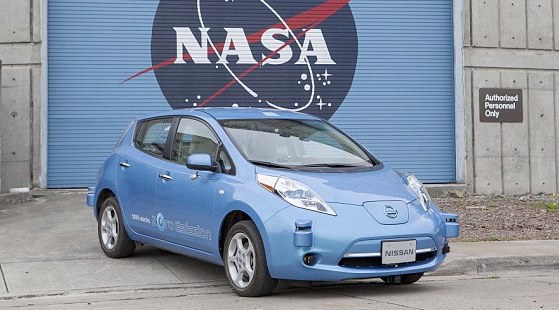
WASHINGTON: Now you can drive ‘Mars Rover’ on Earth as Nasa has teamed up with car manufacturer Nissan to develop new self-driving cars that could be used to race across the surface of Mars.
The technology created during the five-year partnership will also be adapted to create better driverless vehicles that can be used on roads on Earth.
Robotics experts from the space agency will work with engineers from Nissan to adapt the company’s electric Leaf cars. Nissan has pledged to have autonomous cars on the market by 2020, but the technology currently faces significant challenges to cope with the dangers of public roads.
However, Nasa believes sensors and systems being developed to help driverless cars deal with pedestrians, cyclists, overtaking vehicles and parked cars, could also help to develop new robotic rovers for use in exploring other planets.
Currently rovers like Nasa’s Curiosity move at an achingly slow pace over the surface of Mars – it has a top speed of 0.08mph (0.13km/h). This is slow progress is necessary to allow the rover’s computers time to detect and manouvour around obstacles like rocks and deep sandpits that might bog it down.
Such limitations have meant that missions to the Red Planet have explored just a tiny fraction of its surface. The Mars Rover Opportunity has travelled just 25 miles in more than 10 years on the planet.
By adapting technology to be used on Earth’s roads, it could allow rovers to travel at far greater speeds and explore much more of the surface. This could prove crucial in scouting out potential sites for future manned missions to the Martian surface.
Dr Pete Worden, director of Nasa Ames Research Centre in California, told Wired: ‘The more we look at it, the more there are a lot of similarities there. ‘We have a rover on Mars – it is not very autonomous. As we go deeper into space, into more and more dangerous locations, we need to add that autonomy.’
It is not the first project that Nasa and Nissan have collaborated on. In 2005 the two organisations teamed up to develop more comfortable and safer car seats.
Nissan drew upon data from Nasa’s Human Research Program at its Johnson Space Centre that had used experiments from space to examine the neutral body position of astronauts while they were sitting in low gravity.
Nissan used this to build seats for its cars that would lower the amount of fatigue drivers would feel and reduce pressure spots.
Dr Maarten Sierhuis, director of Nissan’s Silicon Valley Research Centre, who spent 12 years working as a senior scientist at Nasa Ames Research Centre, is thought to be the architect behind the latest collaboration. He told Wired: ‘This is a perfect blend of the capability of what the robotics folks at NASA Ames have and the autonomy that we bring.’
In the latest project engineers will begin by conducting online simulations before hoping to get an actual car on the road by the end of 2015. Nasa’s track record in building spacecraft and rovers that are reliable and have significant degrees of latent safety will be invaluable to building autonomous cars for use on Earth.