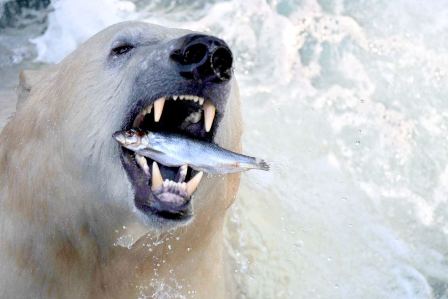
ALASKA – A group of researchers said polar bears forced off melting sea ice will not find enough food to replace their current diet of fat-laden marine mammals such as seals, a conclusion that contradicts studies indicating bears may be benefiting from bird eggs, berries and other land food sources.
Few bears are using land food and what they find can’t replace lipid-rich ringed or bearded seals, said Karyn Rode, a U.S. Geological Survey research wildlife biologist and lead author of the review paper published Wednesday in the journal, Frontiers in Ecology and the Environment.
The paper by federal and academic researchers reviews current polar bear research. It’s aimed at recent research documenting bears feeding on land and suggestions those foods are becoming more important for them, which could increase their chance for survival as summer sea ice recedes, preventing seal hunting.
But not everyone agrees with the conclusions reached by Rode and the other authors at Washington State University and Polar Bear International.
Robert Rockwell, a population biologist and ecologist at City College of New York, who is also affiliated with the American Museum of Natural History, conducted research at western Hudson Bay for 47 years. He watched polar bears change their behavior to eat goose eggs and caribou calves, he said Tuesday.
“I find it hard to believe they’re going to get nothing out of it,” he said.


Polar bears are marine mammals that spend most of their lives on sea ice. They use the frozen ocean to hunt, often catching ringed seals.