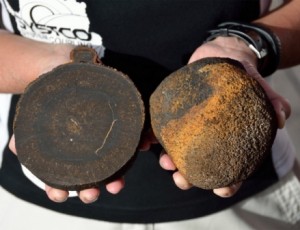


MALI: Scientists searching for deep-sea animals beneath the surface of the Atlantic Ocean recently discovered something else: large metal balls of a rare earth metal known as manganese.
This discovery is important because electronics companies use this metal in the manufacture of high-tech components for items such as smartphones and tablets.
The R/V Sonne, the German research ship responsible for the discovery, dropped mesh nets into the ocean, hoping to nab deep-sea animals for further research. However, their nets brought up balls of manganese instead, ranging in size from that similar to golf balls to bowling balls. After sending down a camera, researchers discovered that these balls covered the seafloor beneath them, making this the largest discovery of manganese nodules in history.
The size of the balls makes this find so extraordinary. Nodules such as these generally take a long time to develop, and only grow at a rate of about one to five millimeters every million years. This means that the larger nodules are at least 10 million years old. Even more interesting, scientists once believed that most of these nodules occurred in the Pacific Ocean, so finding them in the Atlantic makes this a major discovery.
“This discovery shows us how little we know of the seabed of the abyssal ocean, and how many exciting discoveries are still waiting for us,” says Professor Dr. Angelika Brandt from the Center for Natural History at the University of Hamburg.
Although these nodules mostly contain manganese, they also often include other metals such as iron, copper, cobalt and zinc. However, because of the large water depths at which they are usually found, as well as environmental impacts mining could have on ocean life, no one has yet exploited the nodules as natural resources.
These nodules also serve a scientific purpose. Because of how slow they grow, as well as how they form around a pearl-like nucleus, scientists can look at them and figure out what the ocean was like throughout the millions of years the nodules took to form.
Scientists are planning future research cruises, specifically to study these nodules, as well as determine what environmental risks mining would bring to the ocean’s ecosystem.
“We will continue our planned program,” says geologist Professor Dr. Colin Devey from GEOMAR Helmholtz Centre for Ocean Research Kiel. “But the samples obtained here will definitely be examined in detail in our land-based laboratories. We are now excited to see what surprises the Atlantic might still hold for us.

Karachi Port sets 138-year cargo handling record
KARACHI: Pakistan's maritime sector has achieved a major milestone as Karachi Port set a new record in its 138-year history...