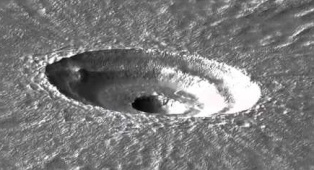


CANADA: Scientists have spotted a huge ice slab under the surface of Mars. More than likely, this frozen polar cap is a result of significant snowfall that occurred thousands of years ago.
The ice slab is the size of California and Texas put together and was discovered beneath the floor of Mars.
Even though Mars is usually a dry and chilly planet, numerous proof of ice indicates that life may dwell on it. Scientist have concluded that since life is found in watery areas on Earth, that the life that’s alleged to live on Mars are hidden in subterranean aquifers.
For several years, the quantity of ice has shifted dramatically as a result of Mars’ unstable axis of rotation. Unlike Earth, Mars lacks a large moon to keep its stability in check, so its rotations are wobbly and unpredictable, which results in constant ice ages.
Scientists have just recently found ice hidden in its mid-latitudes and low latitudes even though ice has been discovered across the poles long before.
Ali Bramson, a planetary scientist from the College of Arizona in Tuscon, said that studying Mars and its water would help determine if the planet can sustain life.
Bramson and her colleagues focused on unusual craters–referred to as Arcadia Planitia–to study the ice. The craters are between 1,075 to 1,410 ft wide. Unlike most craters, these craters had terraces on their partitions.
The ice that was discovered by the scientists is 130 feet thick and lies in Mars’ dust. Bramson stated that it extends down to latitudes of 38 levels, which is akin to someone in Kansas digging in their yard and discovering a huge ice sheet way at the bottom. Ice sheets that deep have not been seen at the latitudes before.
Bramson assumed that the ice sheet is a relic of a previous snowfall that happened millions of years ago. She and her colleagues reported their findings in the Geophysical Analysis Letters journal.

Karachi Port sets 138-year cargo handling record
KARACHI: Pakistan's maritime sector has achieved a major milestone as Karachi Port set a new record in its 138-year history...