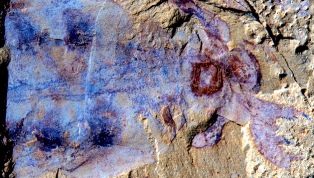
CANADA: Just recently, a group scientists unearthed several fossilized brains of a now-extinct arthropod called Fuxianhuia protensa that was dated to have lived 520 million years ago. The fossils were obtained from Chengjang Shales in Southwest China, a place where many fossil discoveries happen.
The researchers used electron microscopes to picture the tiny brains of the prehistoric creature. The brains appear like flattened carbon films where some were naturally laminated with tiny layers of iron pyrite crystals. They said that the brain structure is much similar to those of modern-day crustaceans.


This is not the first time that Nicholas Strausfeld, study author, tried to prove and presented evidence that brains do fossilize. Back in 2012, he submitted a paper where he detailed a singular brain fossil. Many have laughed about his discovery and called it a bluff.
Why? Because paleontologists insisted that brain tissues can’t and will never fossilize.
So this time around his team wanted to make sure they will reveal a comprehensive case that will leave scientists speechless.
The team recreated the fossilization process in their lab to see if it is, indeed, possible. They tried to find out how the brain of the ancient Cambrian arthropod became almost perfectly preserved.
So in their study, they suggested that brains should be quickly buried for it to be fossilized. They performed the process on sandworms and cockroaches quickly in mud. They believe that the shrimp-like ancient creature was likely buried in a mudslide underwater. They reported that the conditions must be that the brains were buried deep enough with water anoxic enough making the neural tissue not prone to being eaten by predators and bacteria.
In addition, the neural tissue must be able to survive the pressure of being held buried deep with all the weight it carries. Their experiments showed that arthropods have specially dense neural tissues making them capable of surviving such packed and pressured conditions.
Strausfeld, who was also a professor in the Department of Neuroscience at the University of Arizona, said that, “Dewatering is different from dehydration, and it happens more gradually.”
Dewatering process happens when water is slowly squeezed out from the tissue of the creature by the pressure of the mud on top of it.