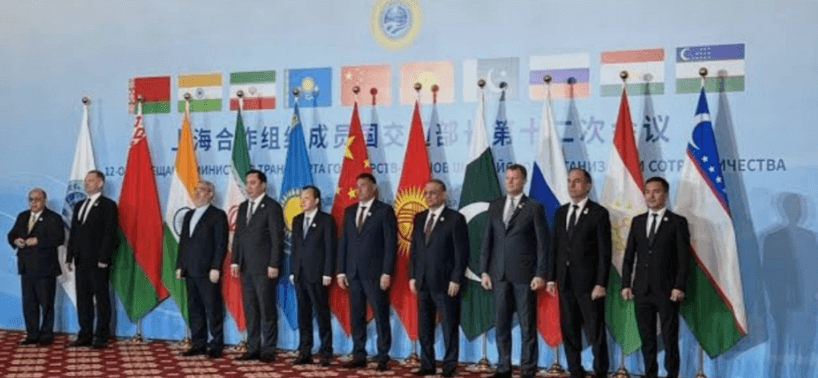
ISLAMABAD: The Shanghai Cooperation Organization (SCO) is placing transport and logistics connectivity at the center of its regional agenda as geopolitical tensions reshape global trade routes and supply chains.
For Uzbekistan, an active member of the organization, stronger transport cooperation is emerging as a strategic priority, creating opportunities to connect Central Asia more closely with China, South Asia, the Middle East and Europe.


Uzbekistan’s freight traffic with SCO member states has grown significantly in recent years. According to figures cited by D. Ibragimova, Head of the Department at the Center for the Study of Transport and Logistics Development Problems under Uzbekistan’s Ministry of Transport, international freight traffic between Uzbekistan and SCO countries increased by around 9 million tons, or 40%, over the past five years.
The volume reached 33.5 million tons in 2025, accounting for about 80% of Uzbekistan’s total international freight traffic. Russia accounted for 33% of the volume, Kazakhstan 32%, China 16% and Kyrgyzstan 10%, said a release issued here by the Embassy of Uzbekistan in Islamabad on Monday.
The author estimates that freight traffic between Uzbekistan and SCO member states could rise to as much as 47 million tons by 2030.
With the SCO now comprising 10 member states, the organization covers a vast geographic area stretching across major parts of Eurasia. This creates significant potential for developing alternative land routes at a time when geopolitical disruptions are increasing pressure on traditional supply chains.
Transport cooperation has consequently become a major component of the SCO’s expanding agenda. Key strategic documents adopted since 2022 have focused on developing efficient transport corridors, digitalizing logistics, promoting decarbonization and strengthening ports and logistics centers.
The 2025 Tianjin Declaration further emphasized the importance of creating new and modernizing existing international transport routes, including the North-South and East-West corridors. It also highlighted digitalization, electronic data exchange and technological innovation as tools for ensuring stable and uninterrupted supply chains.
A major challenge, however, remains the lack of sufficient railway connectivity between several SCO sub-regions. Infrastructure gaps, differences in railway gauges and technical standards, as well as complicated border procedures, continue to limit the creation of an integrated Eurasian rail network.
Against this backdrop, Uzbekistan is supporting several projects with potentially far-reaching regional implications. Among the most important is the China-Kyrgyzstan-Uzbekistan railway, construction of which officially began in Kyrgyzstan’s Jalal-Abad region in December 2024.
The approximately 532.5-kilometer railway will include stations, bridges and tunnels. Preliminary estimates suggest that it could carry 8 million tons of freight annually by 2030, increasing to 10 million tons by 2040 and 13.5 million tons by 2050.
The project could provide a new connection between China and Central Asia while creating opportunities for future links toward South Asia and Indian Ocean ports.
Another strategically important initiative is the Uzbekistan-Afghanistan-Pakistan railway. The proposed line could establish a shorter overland connection between Central and South Asia, linking Eurasian markets with Pakistan’s seaports and, potentially, India and Southeast Asia.
Preparatory work has already included field studies, digital terrain mapping and development of the technical component of a preliminary feasibility study. In July 2025, Uzbekistan, Afghanistan and Pakistan signed a framework intergovernmental agreement on preparing a feasibility study.
Preliminary estimates cited from EY suggest the corridor could handle up to 22 million tons of cargo annually by 2030 and 34 million tons by 2040, with transit freight expected to account for a substantial share.
The broader objective is to integrate these projects rather than develop them as isolated routes. A connected network could support multi modal corridors linking China, Central Asia, Afghanistan, Pakistan and India, while also strengthening routes through Iran and Türkiye toward European markets.
Uzbekistan has also proposed institutional mechanisms to support this integration. The planned Council for the Integration of SCO Railway Spaces is designed to address differences in railway gauges, technical standards, rolling stock requirements, border procedures and transport documentation.
If these initiatives advance in coordination, the SCO could evolve from a primarily political and security-oriented organization into an increasingly important platform for Eurasian transport integration. For Uzbekistan and other landlocked economies, the emerging network could open new markets, attract transit cargo, strengthen supply-chain resilience and transform geographical constraints into strategic logistical advantages.