
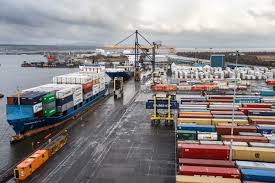
WASHINGTON: At the Port of Dundee on the east coast of Scotland, two signs of the North Sea’s past and future stand side by side. A few hundred metres from where an oil drilling rig is moored, with its crew awaiting their next job, a new quayside for vessels and equipment used to decommission North Sea oil and gas fields is under construction. The 200m-long jetty, which is also intended to attract more offshore wind work, is part of a £10m expansion project to make sure the historic port is prepared for when the sun finally sets on North Sea oil. It is estimated that up to 20bn barrels of oil and gas could still be recovered from beneath the waters off the coast of Britain. But several historic harbours in Scotland, which rely on oil and gas traffic for a sizeable proportion of their revenues, are already looking at how to “future proof” their businesses.
North of Dundee, the managers of Aberdeen Harbour — which was established in 1136 and typically relies on oil and gas for 50 to 60 per cent of its business — are pushing ahead with a £350m expansion project to secure new business, both from decommissioning and from other sectors, such as cruise ships. These historic ports are used to seeing major industries come and go. “Back in 1995 when Forth Ports bought the port [in Dundee] it was still handling jute,” says Charles Hammond, chief executive of the private company that owns the Port of Dundee, in a reference to the city’s once-thriving jute mills that ultimately fell victim to cheaper competition from India. North Sea oil and gas work is currently one of the biggest contributors to the Port of Dundee’s revenues, along with agricultural products, such as fertilisers, and other cargo, including timber, steel and iron. “I would expect to see with investment . . . decommissioning and offshore wind will be two of largest areas of business with agriculture and general cargo,” says Mr Hammond.
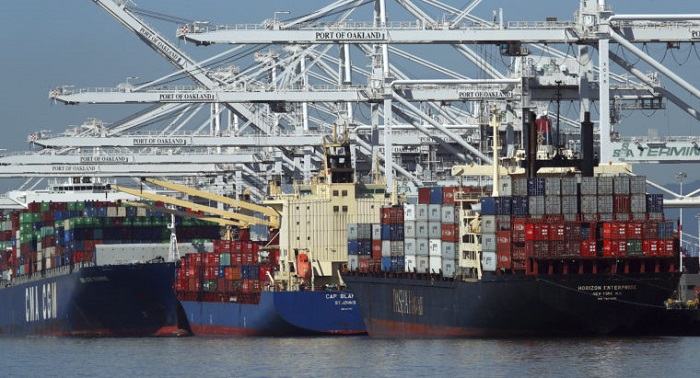

The port estimates that 326 North Sea oil and gas fields will be “sub economic” — or unprofitable — by 2030 and will need to be retired. It is also optimistic about the UK government’s continued subsidy support for offshore wind farms, many of which are located or planned for sites off the east coast. Meanwhile, Aberdeen’s expansion will allow it to accommodate larger vessels, whether commercial cargo boats or barges used for decommissioning. It is also hoping to attract much larger cruise ships, capable of carrying as many as 3,000 passengers. “We are responding to almost a 30-year trend in vessels getting larger,” says Chris Bain, a director at Aberdeen Harbour Board, which manages the port. The retirement of oil and gas fields is already taking place in the North Sea, but decommissioning is still regarded as an “emerging” sector. It accounted for just 5 per cent of total spend by the North Sea oil and gas industry in 2015, according to Oil & Gas UK, a trade body. There are various forecasts of the total clean-up bill for the North Sea, which will be subsidised in part by the taxpayer. The Oil and Gas Authority, a regulator, recently put the estimated cost at £60bn. “Decommissioning is not that sexy, it’s a logistics and waste management project,” admits Callum Falconer, chief executive of a Dundeecom, a public-private partnership promoting decommissioning in the city. It may not be glamorous, but operators are not able to avoid it; EU rules dictate they must return the marine environment to its natural state after they have finished their operations.
Scottish harbours will face competition for decommissioning work from Norway, which has ultra-deepwater ports that accommodate big vessels capable of handling the biggest decommissioning projects. The Scottish National party is keen to build an ultra-deepwater port in Scotland. But existing ports operators believe they can save oil and gas companies money by catering to cheaper barges that transport material lifted from decommissioned fields in one to two days. This saves the need larger decommissioning vessels, which are expensive to lease, from sailing back and forth to Norway.
The Port of Dundee has agreed a joint venture with a large Norwegian industrial company, AF Gruppen, which owns the North Sea’s most advanced facility for decommissioning offshore projects, on Norway’s south-west coast. It believes the joint venture is a sign of confidence there is plenty of work to go around. Even so, Scottish ports operators are keen to stress they are not putting all their eggs in one basket. They are all too aware that industrial cities in the UK have often learnt the hard way that the decline of a single dominant industry can spell economic disaster. Sandra Laurenson, chief executive of Lerwick Port Authority in Shetland, which has already spent £12m improving its facilities, says current revenues from the oil and gas industry will not be replaced like-for-like by decommissioning income, especially as a significant proportion of the cost of retiring oil and gas fields will be spent offshore, on activities such as plugging and abandoning wells. “The portion of the spend that actually ends up in a yard is quite small.”
