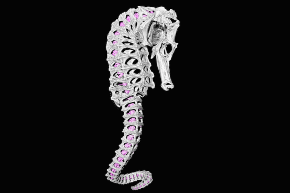


DUBLIVE: An international team of researchers has examined the skeletal structure of one of the ocean’s most spectacular sea creatures – the seahorse.
The seahorse belongs to the Hippocampus genus, an ancient Greek word that roughly translates as “horse sea monster.” The small creatures are typically found in tropical and temperature waters, using their camouflage to prey on small crustaceans and larval fish.
The seahorse is a bony, scale-free organism that has its skin stretched across numerous plates of bone; these plates are organized into a series of rings that surround its vertebral column. The researchers looked at the seahorse’s unusual skeletal structure in finer detail, including the tail region.
The seahorse’s prehensile tail has evolved over many millions of years. While it serves no function in aiding the creatures motility, it provides the animal with the ability to grasp chunks of coral reef and seaweed. This helps to stabilize the seahorse, as it patiently waits for food to float by.
The tail is also surprisingly flexible, bending and turning with ease, returning to its original shape much better than the cylindrical tails of other animals. Pairs of seahorses often clutch each others’ tails during courtship, spinning around each other during a “predawn dance” – a ritual that synchronizes their reproductive states.
An assistant professor in the College of Engineering at Oregon State University, Ross Hatton, recently explained that his team’s research endeavors could pave the way for developing more flexible robots.

Karachi Port sets 138-year cargo handling record
KARACHI: Pakistan's maritime sector has achieved a major milestone as Karachi Port set a new record in its 138-year history...