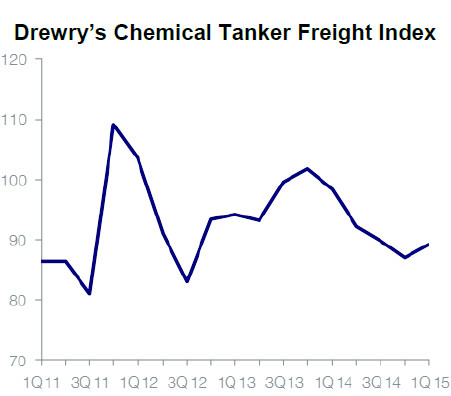
A new tool to assess the state of the Hellenic ship financing market has been released by the market leader in this field, Petrofin Research. Petrofin Index, unique in shipping, is designed to inform the shipping public of the state and development over time of Greek ship finance. Starting with a base of 100 in 2001, when the first Petrofin Bank Research © on Greek ship finance commenced, the index as of the end of 2014 rose to 388, e.g. a cumulative annual growth of 11% over the last 13 years. However, as readers may see from the below graph, the Petrofin Index rose to a peak of 443 in 2008 but has fallen, thereafter, to a low of 378 in 2013. Indeed the rise to 388 at the end of 2014 reflects a rise from the low of 378 last year.
According to Petrofin, “the main reasons for the fall in the Petrofin Index from 2008 to 2013 relate to the deleveraging of western banks following the 2008 financial crisis, the more stringent capital adequacy controls under Basle III, the collapse of the LIBOR market, the re-appraisal by western banks of their ship finance involvement, the poor performance of the shipping markets and the existence of tonnage surpluses adversely affecting vessel values and earnings, as well as the lingering effects of the Greek crisis. On the other side, the robust growth of Far Eastern bank lending and the emergence of some counter cyclical western lenders has slowed down the fall in the Petrofin Index, coupled by the higher demand for lending due to record newbuilding orders by Greek owners. The renewed Greek crisis and the collapse of dry bulk shipping have imposed greater strains in Greek ship finance over the last six months and it is expected that such factors shall influence the forthcoming 2015 Petrofin Index. It is Petrofin Research’s intention to publish the Petrofin Index at least once per annum together with comments on its course and prospects”.

In its latest annual report, Petrofin said that the overall Greek loans (drawn and committed but undrawn) rose to $64.019 billion by the end of 2014, 4.1% higher than the $61.498 billion of 2013. According to Petrofin Research, “drawn loans are up by 2.85% and Commitments by 18.11%, the latter prompted by the high Greek newbuilding orders. Of the 5 Greek banks active in the shipping finance market, National Bank of Greece shows an increase by 7.33% and Aegean Baltic by 11.99%. The rest show minor decreases”.
Overall, Greek banks’ exposure is up by 3.17% to a total of $10,8 billion, reflecting the increased stability in 2014 for Greek banks. This increase is the first sign of a recovery, since 2008. Now that the dust form mergers and acquisitions has subsided, the Greek banks are showing a slight rise in their portfolio, which is quite admirable in the current banking climate of Greece.
Among Greek banks, Piraeus Bank ranked in third place of the total shipping portfolios with loans of $3.85 billion, followed in fourth place by the National Bank of Greece, which controls a shipping loan portfolio of $2.933 billion. Alpha Bank ranked in 8th place overall with a portfolio of $2.42 billion, while Eurobank took fourth place among Greek banks and 20th overall with a portfolio of $1.315 billion. Finally, Aegean Baltic took 30th place overall with a loan portfolio of $201 million.
Meanwhile, international banks with a Greek presence continue to reduce their exposure, in 2014, by 4.23%, compared to a reduction of 9.35% in 2013 and a reduction of 3.9% in 2012.
International Banks without a Greek presence show an impressive increase of 17.23%.
The number of banks involved in Greek shipfinance has risen to 49 from 46 banks last year, as some new players now entered cautiously. The top 10 Greek ship financing banks have reduced their portfolios by 4%, resulting to a decrease in their market share down to 57.24% ($36.6bn) from 62.38% in the previous year ($38.3bn). But the next 10 banks have increased their market share by 3.05% with an increase of 17.6% in their portfolios to $17bn from $14.46bn”.
Analysing the market, Petrofin Research noted that “the poor dry bulk market has allowed the development of non-banking finance, to develop on the basis of the limited interest by traditional banks. This trend is expected to continue. As such, the banking ship finance totals understate the actual level of finance obtained by Greek owners, as there are no figures available for non-banking finances.
The assumption of supervisory responsibility by the ECB for all EU banks is a welcomed development and is expected to comfort depositors that all banks within the EU would be subject to uniform rules of compliance and capital adequacy. Over time, this should enable the return of the interbank market to levels that would reflect (at least in part) the levels reached before the financial crisis. This would assist the funding of commercial banks, as they recommence their expansion, when their deleverage process would come to an end.
Looking ahead to the next couple of years, it would appear that Greek ship finance may not continue to grow, as a greater number of banks are re-aligning their ship lending budgets and await a prolonged shipping recovery and/or are reviewing the quality of their existing loan portfolios”, said Petrofin.
The report concluded that “thus far, new bank lenders have been few and can mostly be found in local Far Eastern and Middle Eastern banks, providing some finance to Greek owners with a Far Eastern presence. Such loan volumes are not high but local names have started to appear in new shipping loans. The demand for newbuilding finance continues unabated, as a huge part of the current order book remains not financed. However, Greek owners are increasingly needed to delve deeper into their pockets for additional capital as often commercial values have fallen to levels below newbuilding contracted ones. A number of owners are currently negotiating newbuilding delivery extensions with the shipyards, in order to allow more time to take delivery, in the hope that both the market and ship finance conditions shall improve.
In conclusion, therefore, the banking ship finance market shall continue to be restrained in the years to come and Greek ship lending is not expected to rise in line with the development of the Greek fleet and the level of newbuilding deliveries, as owners shall increasingly rely on non-banking sources of finance, as well as their own resources, to meet the industry’s challenges”.
Nikos Roussanoglou, Hellenic Shipping News Worldwide