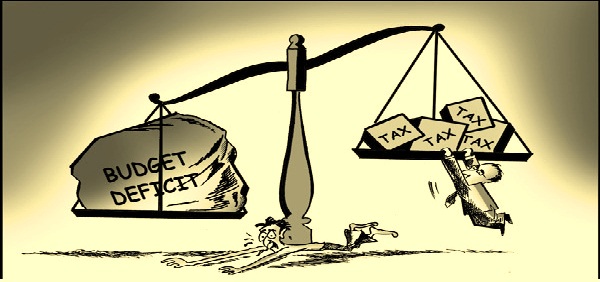
ISLAMABAD: The budget deficit has increased to 3.7 percent of the GDP or Rs1.24 trillion during nine months (July-March) of the current fiscal year mainly due shortfall in tax collection and massive expenditures.
The government had fixed the budget deficit target at 3.8 percent of the GDP (Rs1.276 trillion) for the current financial year. However, the government had revised the target to 4.1 percent of the GDP (Rs1.375 trillion) due to the massive shortfall in taxes.
According to the documents of the Ministry of Finance, the expenditures were recorded at Rs4,383.6 billion (13.1 percent of the GDP) as compared to revenues of Rs3,145.5 billion (9.4 percent of the GDP), taking the deficit to Rs1238.04 billion.
In expenditures, the government had spent Rs535.7 billion on the country’s defence, which is 62.3 percent of the annual defence budget of Rs860.2 billion. Similarly, a massive amount of Rs1094.5 billion had been spent on paying the country’s interest on domestic as well as foreign borrowings.
The government had earmarked Rs1,360 billion in annual budget for paying interest on domestic as well as foreign loans during fiscal year starting from July 2016 to June 2017. The government had spent Rs324 billion on federal developments projects during July-March period of the ongoing financial year.
Meanwhile, the provincial governments had spent Rs422.7 billion on the development projects. The documents showed that the government spent Rs208.9 billion on pension payments, Rs81.89billion on public order and safety affairs, Rs58.92 billion on education, Rs10.08 billion on health and Rs7.49 billion on recreation, culture and religion.
Of the total revenues of Rs3145.5 billion, the government has collected around Rs451.18 billion as non-tax revenues during the first nine months of the present fiscal year. In non-tax revenues, the government collected Rs12.08 billion as mark-up on public sector entities, Rs22.08 billion as dividend, Rs144.79 billion as profit of State Bank of Pakistan, Rs64.43 billion as defence, Rs13.59 billion as passport fee and Rs3.6 billion as discount remained on crude oil, Rs40.3 billion as royalties on gas and oil, Rs1.03 billion as windfall levy against crude oil and Rs86.97 billion through other sources.
The Federal Board of Revenue (FBR) had faced a massive tax collection shortfall of Rs168 billion during nine months (July-March) of the year 2016-17. Similarly, the government is struggling to meet non-tax collection target. Major component of the non-tax collection is the Coalition Support Fund (CSF) from the United States. Pakistan has received only $550 million under CSF during FY2017 as against the projection of $1.65 billion or Rs170 billion for the whole fiscal year. It is unlikely that Pakistan will receive the full amount of $1.65 billion before the end of June 2017.