You might also like


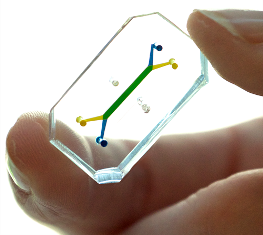
PARIS: The silicon chips that have won London Design Museum’s Design of the Year Award for the year 2015 might look like regular pieces of plastic ornamented with some attractive patterns, but in reality they are lined with human cells. These chips have the potential of revolutionizing medical trials by crafting cures for people and reducing the requirement for animal testing.
The above mentioned award happens to be the most prestigious design award in the UK and was set up by the museum eight years back. One of the most well known recipients of the award is the Olympic torch used in the 2012 London Games.
This year’s recipient of the award i.e. Organs-on-Chips were designed by Dan Dongeun Huh and Donald Ingber at the Wyss Institute of Harvard University. These revolutionary chips are results of a seven year long research. They are basically micro devices lined with a series of living human cells that act exactly like catual tissues; they mimic motions and functions of human organs Cell such as intestines, lungs, liver and so on.
architects now possess the ability of recreating different human organs, for instance, a living and breathing lung, on a micro chip; this allows them to study effects of different bacteria or pharmaceutical drugs on them.
The team of experts representing Emulate Inc., a wing of the Wyss Institute for Biologically Inspired Engineering and the company that develops Organs-on-Chips, feels that the systems that are currently in use for testing effects of drugs and organisms on human organs are not up to the mark and cannot replicate responses and reactions of human cells accurately. For those who don’t know: the majority of the tests conducted nowadays involve use of animals or cells in Petri dishes.