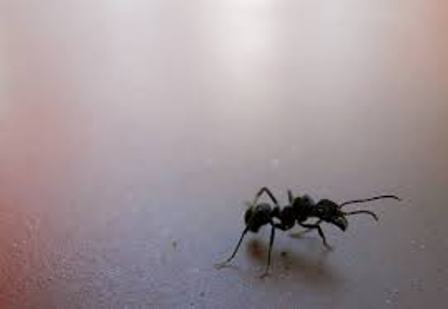
MEXICO: Lab colonies of worker ants were studied under four scenarios — single ants, groups of two, ten, and single workers with three to four medium-sized larvae.
The isolated ants lived just six days, whereas group-living ants lived up to 66 days, the scientists report in journal Behavioural Ecology and Sociobiology .
The scientists say their results show that ants simply don’t know how to behave when alone.
“Isolated ants exhibited a much higher activity after social isolation, continuously walking without any rest,” says study co-author Dr Laurent Keller, an entomologist from the University of Lausanne.


This behaviour is a recipe for trouble as the ants don’t get enough energy to back it up, explains study co-author Dr Koto Akiko of the University of Tokyo.
“Because of this hyperactivity, isolated ants faced an increased energy demand”, says Akiko.
“Isolated ants ingest as much food as their grouped nest mates, but the food is not processed fully by the digestive tract”, he adds.
Energy imbalance
Under normal conditions, carpenter ants go out to the field and collect food on a specialised internal structure called crop. Food stored here is not consumed immediately by the ant, but rather taken to the nest for sharing and for their own consumption.
“[Isolated ants] retained food in the crop instead of digesting it which resulted in an imbalance of energy income and expenditure”, says Keller.
The scientists say the findings indicate that food intake alone is not enough, suggesting that social interactions are a key aspect for the ant’s proper digestive functions, so that food can go beyond the crop and into their stomach.