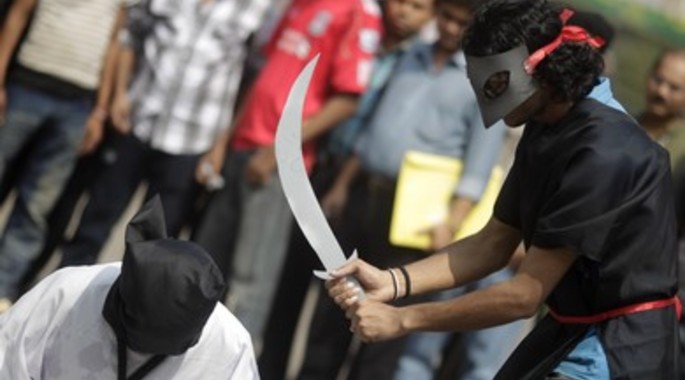
JADDAH: Niaz Mohammad Ghulam Mohammad, who was caught by Saudi Customs in crime of smuggling the heroin through his intestines, has been beheaded by Saudi Arabia. He, being the 67th person beheaded for drug trafficking this year.
Niaz Mohammad Ghulam Mohammad appears to have swallowed the drugs. Rights groups are concerned about surge in executions in past months.


Niaz Mohammad Ghulam Mohammad was executed in Kharj Governorate in the Riyadh Region because he tried to smuggle ‘a large quantity of heroin inside his intestines into the Kingdom of Saudi Arabia’, the Ministry of Interior stated. His death brings the number of foreigners and Saudis executed by the Kingdom for crimes this year to 67, despite concerns expressed by the international community.
This is compared to 69 for the whole of last year, according to Human Rights Watch. The fact that the heroin was found within the man’s intestines suggests he would have ingested the drugs by swallowing a package – a common means for mules to transport illegal drugs.
The Saudi Press Agency reported that a statement from the Ministry said a royal order was issued to execute the death sentence.
It added that ‘the Government of the Custodian of the Two Holy Mosques King Abdullah bin Abdulaziz Al Saud is keen on combating narcotics due to their great harm to individuals and the society’.
The statement concluded by saying the Ministry is ‘warning anyone who tries to commit such actions that he will be punished according to Sharia’.
Under the Saudi Sharia legal system it can actually be harder to avert execution for crimes without a specific victim, like drug smuggling, than for murder.
Of the 59 people executed by mid-October, 22 had been convicted for smuggling drugs, according to figures compiled by Human Rights Watch from Saudi media reports.
One Saudi man, Mohammed Bakr al-Alaawi, was put to death for sorcery so far this year, the third such case since 2011. Although such cases are even rarer, judges can also demand execution for adulterers or Muslims who abandon their faith.
In Saudi Islamic law, charges of violent crimes like murder are usually brought under the system of ‘qisas’, which is retaliation on the principle of an eye for an eye.
While a murderer would normally be sentenced to death, the victim’s family is permitted to accept ‘diyya’, or blood money, instead of execution. The lives of women are worth half those of men, and non-Muslims a fraction of the value of Muslims.
A statement said King Abdullah bin Abdulaziz Al Saud is keen on combating narcotics due to ‘their great harm to individuals and the society’
Convicts from less wealthy backgrounds, or without tribal connections, who might intercede with the family or tribe of the victim, are more likely to die because it is harder for them to arrange a blood money payment.
‘Any execution is appalling, but executions for crimes such as drug smuggling or sorcery that result in no loss of life are particularly egregious,’ said Sarah Leah Whitson, Middle East and North Africa director for Human Rights Watch.
Saudi Arabia has no civil penal code that sets out sentencing rules, and no system of judicial precedent that would make the outcome of cases predictable based on past practice.
King Abdullah announced plans for legal reform in 2007, but judges, drawn from the traditionally conservative clergy, have so far succeeded is putting off meaningful change.
In 2009 Abdullah replaced the long-serving, conservative justice minister with a younger scholar, Mohammed al-Issa.
His attempts to introduce more modern training for judges and a system of precedent to make sentencing more predictable have so far was blocked by strenuous opposition from conservatives.
Even Saudis who want reform generally do not oppose the use of the death penalty by public beheading.
In the most extreme version of the Saudi death penalty, known by the Arabic word for ‘crucifixion’ and reserved for crimes that outrage Saudi society, the corpse is publicly hanged in a harness from a metal gibbet as a warning to others.
An online film dated April 2012 on the LiveLeaks website shows a man being executed and then ‘crucified’ in this manner, reportedly for robbing a house and killing its occupants.
A group of five men suffered this fate in May last year in the southern province of Jizan for a series of robberies