Customs Today
  • Home
  • Islamabad
  • Karachi
  • Lahore
  • National
  • Transfers and Postings
  • Chambers & Associations
  • Business
No Result
View All Result
Customs Today
  • Home
  • Islamabad
  • Karachi
  • Lahore
  • National
  • Transfers and Postings
  • Chambers & Associations
  • Business
No Result
View All Result
Customs Today
No Result
View All Result
Home Science & Technology Science

Solar shockwaves can impact Earth’s radiation belts couple of times each month

byCustoms Today Report
10/03/2015
in Science
Share on FacebookShare on Twitter

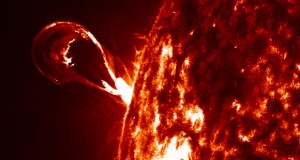
NEW YORK: A team of scientists has observed in detail for the first time the effects of a solar shockwave on the Earth’s radiation belts from the beginning to the end.

The shockwave struck a massive blow to the Earth’s magnetic field, setting off a magnetised sound pulse around the planet on October 8, 2013.
You might also like

Astronomers discover distant dwarf planet beyond Neptune

12/07/2016

Nasa’s Juno successfully begins orbit of Jupiter

05/07/2016

The resulting magnetosonic pulse, lasting just 60 seconds, reverberated through the Earth’s radiation belts, accelerating certain particles to ultrahigh energies.

“These are very lightweight particles, ‘killer electrons’ – electrons that can go right through a satellite,” said John Foster, associate director of Massachusetts Institute of Technology’s (MIT) Haystack Observatory.

These particles are accelerated and their number goes up by a factor of 10 in just one minute.

“We were able to see this entire process taking place and it is exciting. We see something that, in terms of the radiation belt, is really quick,” he added.

Solar shockwaves can impact Earth’s radiation belts a couple of times each month.

“The event in 2013 was a relatively minor one,” Foster noted.

On October 8, 2013, an explosion on the sun’s surface sent a supersonic blast wave of solar wind out into space.

This shockwave tore past Mercury and Venus, blitzing by the moon before streaming towards Earth.

NASA’s Van Allen Probes, twin spacecraft orbiting within the radiation belts deep inside Earth’s magnetic field, captured the effects of the solar shockwave just before and after it struck.

Scientists at MIT’s Haystack Observatory, the University of Colorado and elsewhere analysed the probes’ data and observed a sudden and dramatic effect in the shockwave’s aftermath.

The findings were published in the Journal of Geophysical Research.

Related Stories

Astronomers discover distant dwarf planet beyond Neptune

byCT Report
12/07/2016

LONDON: A dwarf planet half the size of Britain has been found tumbling through space in the most distant reaches...

Nasa’s Juno successfully begins orbit of Jupiter

byCT Report
05/07/2016

MIAMI: Nasa's unmanned Juno spacecraft has begun orbiting Jupiter, a key triumph for a $1.1 billion mission that aims to...

Coal dust kills 23,000 per year in European countries

byCT Report
05/07/2016

PARIS: Lung-penetrating dust from coal-fired power plants in the European Union claims some 23,000 lives a year and racks up...

Helium shortage could be solved by new life-saving discovery

byCT Report
28/06/2016

LONDON: Scientists might finally have overcome a global shortage of helium – potentially saving millions of lives in the process....

Next Post

Sony verifies Android 5.0 Lollipop updates for entire Xperia Z series including smartphones, tablets at MWC

  • Terms and Conditions
  • Disclaimer

© 2011 Customs Today -World's first newspaper on customs. Customs Today.

No Result
View All Result
  • Transfers and Postings
  • Latest News
  • Karachi
  • Islamabad
  • Lahore
  • National
  • Chambers & Associations
  • Business
  • About Us

© 2011 Customs Today -World's first newspaper on customs. Customs Today.