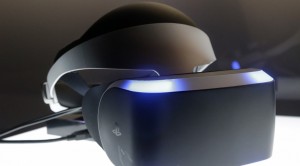
SAN FRANCISCO: Sony Corp plans on putting its virtual-reality (VR) headset on the market next year. The gaming and electronics company on Tuesday announced at the Game Developers Conference (GDC) in San Francisco that its VR system, nicknamed Project Morpheus, will debut in the first half of next year.
VR technology utilizes a head-mounted display in concert with head-tracking capabilities to transport wearers’ to virtual worlds.It’s the first time the gaming giant has attached a date to Morpheus, and it formed part of a healthy bundle of news surrounding the Playstation-linked headset.
You might also like


Replacing the five-inch LCD, there is now a 5.7-inch 1080p OLED screen which expands the field of view and removes motion blur. making the virtual much more like reality.
This is double the rate of the now previous generation, and means games can be rendered through Morpheus in 120 frames per second. What this means is clearer, smoother visuals and an altogether improved experience.
This refers to how the viewpoint follows the movement of the head. Lag or delay is obviously bad, and Sony say they have now got latency down to 18 milliseconds – half of what it used to be. This “delivers a sense of presence” more than previously.
Aiming to improve the positional tracking of Morpheus, Sony has confirmed the addition of three new LEDS to the headset, bringing the total to nine on the device, for better 360 tracking of head movement, which can then be better displayed in-game.
The Morpheus headset itself has also been given some TLC, and while it has never looked like a rough prototype, it now looks closer to a consumer product than ever. There’s now a single band to hold the headset in place, as well as a release button so it’s easy to take off. Sony says it has also tweaked the weight distribution, with more of it now going through the headband – taking pressure off the face. They’ve also made Morpheus lighter, with the aim of making it more comfortable.
The range of updates comes at a key time for Sony, because the already mentioned HTC Vive could be a real competitor in the gaming VR circuit. Why? Because it has been developed in partnership with Valve, one of the biggest and best gaming studios around – makers of series like Half-Life and Portal, but also the creators of the Steam platform.
That all means the Vive has huge potential on the gaming front – and should kick-start something of a VR arms race between the two.