Customs Today
  • Home
  • Islamabad
  • Karachi
  • Lahore
  • National
  • Transfers and Postings
  • Chambers & Associations
  • Business
No Result
View All Result
Customs Today
  • Home
  • Islamabad
  • Karachi
  • Lahore
  • National
  • Transfers and Postings
  • Chambers & Associations
  • Business
No Result
View All Result
Customs Today
No Result
View All Result
Home Science & Technology Science

Space probe launched to detect for gravity waves

byCT Report
07/12/2015
in Science, Science & Technology
Share on FacebookShare on Twitter

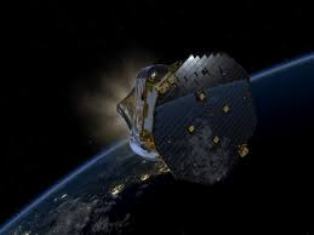
MEXICO: A space probe designed to detect gravity waves in space-time, predicted 100 years ago by Albert Einstein in his general theory of relativity, has been successfully launched into orbit.

The European Space Agency’s Pathfinder spacecraft was launched from Kourou in French Guiana just one day after the 100th anniversary of Einstein’s groundbreaking theory being published.


You might also like

Tesla driverless system to use updated radar technology

12/09/2016

Apple to develop its own self-driving technology

10/09/2016

Scientists had hoped to launch it on Dec. 2, the anniversary date, but the launch was delayed a day due to technical problems with the Vega launch rocket.

The better-safe-than-sorry decision didn’t seem bother the scientists.

“We’ve waited 100 years for the anniversary of Einstein’s equations. What’s one more day?” said Paul McNamara, a team member on the ESA project.

In orbit, two gold-platinum cubes will be released into free-fall inside the space probe, where they will be isolated from all outside forces except for gravity.

Measuring their position relative to each other with extreme sensitivity will give researchers a chance at detecting gravitational waves, tiny ripples in space-time Einstein said should spread outward as massive objects such as neutron stars and supermassive black holes or neutron stars interact.

Despite years of experiments and studies, gravitational waves have proved to be an elusive query and have yet to be directly detected.

A series of thruster burns over the next two weeks will push Pathfinder toward its operations orbit, a point it should reach in about 10 weeks, ESA scientists explained.

On Feb. 15, pins holding the gold-platinum cubes in place will be withdrawn, allowing the cubes to float in free-fall, where their positions will be measured using lasers.


Related Stories

Tesla driverless system to use updated radar technology

byCT Report
12/09/2016

WASHINGTON: Electric carmaker Tesla announced Sunday it was upgrading its Autopilot software to use more advanced radar technology. In a...

Apple to develop its own self-driving technology

byCT Report
10/09/2016

SAN FRANCISCO: Apple may not become an automaker, but it still wants to develop its own self-driving technology. The iPhone-maker's...

NASA spots slowest known magnetar

byCT Report
10/09/2016

WASHINGTON: Astronomers have found evidence of a magnetar - magnetised neutron star - that spins much slower than the slowest...

‘YouTubers’ outshining old-school television

byCT Report
09/08/2016

SAN FRANCISCO: A media revolution is taking place, and most people over 35 years of age aren’t tuned in. Millennial...

Next Post

Archaeologists discover cultural heritage of southern Sindh

  • Terms and Conditions
  • Disclaimer

© 2011 Customs Today -World's first newspaper on customs. Customs Today.

No Result
View All Result
  • Transfers and Postings
  • Latest News
  • Karachi
  • Islamabad
  • Lahore
  • National
  • Chambers & Associations
  • Business
  • About Us

© 2011 Customs Today -World's first newspaper on customs. Customs Today.