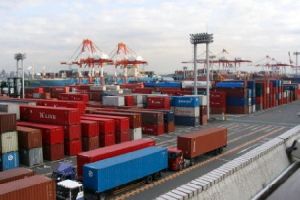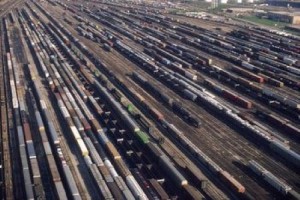
LONDON: To ensure speedy clearance of cargoes from the nation’s seaports as it is obtainable in the developed world, stakeholders in the maritime industry have called for the quick connection of the terminals to railway lines.
They argued that if all major seaports in the country were connected by rail transport system, it would ensure easy evacuation of goods in the next five years.
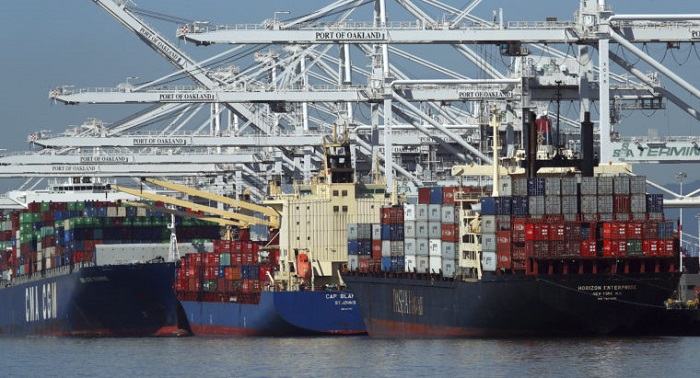

This is coming on the heels of the fear expressed in some quarters that the expected volume of cargoes into Nigeria by 2020 cannot be evacuated only by road without experiencing unprecedented congestions.
The stakeholders also called for quick completion of the proposed new ports in the country. These include the ones situated in Ibeno, Akwa Ibom State; Agge, Bayelsa State; Badagry and Lekki, Lagos State; and Ogeingbe, Delta State.
They maintained that the completion of these new ports was vital to the sustainable development of the country since the volume of cargoes expected into Nigeria in the next five years will be so high such that the present seaports cannot accommodate them.
The views of the stakeholders contained in a communiqué issued at the end of the 2015 Maritime Platform national discourse organised by Platforms Communications with the theme “Nigerian maritime sector in the next 5 years: Deciding where we want to be”.
The stakeholders include the Chairman, Ports Consultative Council (PCC), Chief Kunle Folarin; President, Women in International Shipping and Trading Association, Nigeria (WISTA), Mrs. Jean Chiazor-Anishere; and the Registrar, Council for the Regulation of Freight Forwarding in Nigeria (CRFFN), Sir Mike Jukwe.
Others are the President, Ship owners Association of Nigeria (SOAN); Mr. Greg Ogbeifun; founder, National Association of Government Approved Freight Forwarders (NAGAFF), Chief Boniface Aniebonam; and the President, Nigeria Ship owners Association (NISA), Captain Dada Labinjo.
They stated that in the next five years, the single window initiative by the Nigerian Customs Service (NCS) should be fully integrated and operational such that human contact in cargo clearance would be completely eliminated through automation of all cargo clearance processes and procedures. According to them, by so doing, corruption will be drastically reduced if not eradicated in Nigeria cargo clearance system.
On funding, they called on the Central Bank of Nigeria (CBN) should in the next four months compel commercial banks to provide at least 10 per cent lending regime for the maritime sector, as it is doing presently with agriculture and industry sectors.
In the same vein, they called on the federal government to establish the much needed maritime bank to fund maritime projects and meet financial requirements of the sector in the next three years.
They stated that banks, through their Research and Development (R&D) departments, should design products for financing development of inland water transport (IWT) sufficient to cause a change and repositioning of IWT in the next five years.
According to the stakeholders, by so doing, maritime sector of the economy will have a guaranteed funding corridor to finance shipping development.
“In the next five years, no foreign vessel should be allowed to carry Nigerian crude oil because Nigeria has primordial advantage in domestic trade and indigenous ship owners must be encouraged to grow their fleets through adequate funding and the disbursements of the Cabotage Vessel Finance Fund (CVFF) to enable them acquire specialised crude-carrier vessels.
The Nigerian Maritime Administration and Safety Agency (NIMASA) should collaborate with NCDB, NNPC and PPMC to ensure cohesive enforcement of the Cabotage Act by immediately stopping foreign vessels from carrying Nigerian refined petroleum product because Nigeria has about 373 Cabotage vessels which are qualified enough to carry the nation’s refined oil products.
“This is because according to current statistics, Nigeria consumes 1.8 billion metric tons of oil per month, which means that with only 8 vessels carrying 5000 metric tons each per day, indigenous ship owners currently have sufficient capacity to carry Nigerian refined petroleum products if given the jobs. Maritime stakeholders should henceforth be consulted and fully engaged in all policy-formulation and implementation in the sector; and policy should be geared towards development to avoid failure”, the communiqué added.
They also called for the integration of all stakeholders’ interest groups to create a platform for a stronger advocacy in order to get policy makers and approving authorities to understand and implement our positions.