
Customs Today
  • Home
  • Islamabad
  • Karachi
  • Lahore
  • National
  • Transfers and Postings
  • Chambers & Associations
  • Business
No Result
View All Result
Customs Today
  • Home
  • Islamabad
  • Karachi
  • Lahore
  • National
  • Transfers and Postings
  • Chambers & Associations
  • Business
No Result
View All Result
Customs Today
No Result
View All Result
Home Science & Technology Science

Strange Spiders found in UK that can trap prey using electrically charged webs

byCustoms Today Report
30/01/2015
in Science, Science & Technology
Share on FacebookShare on Twitter

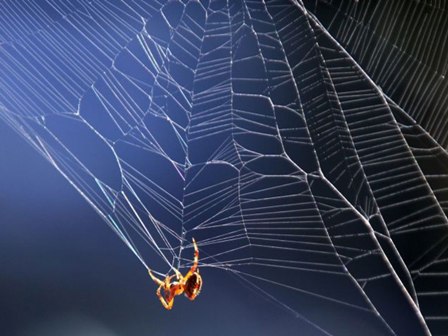
HONG KONG: A common type of spider has been discovered to have the ability to trap and subdue its prey using electrically charged silk webs.

Researchers have been interested in spider silk for years because of its amazingly high tensile strength for its thickness. Now scientists are gaining new insights on the smallest of the small: the ultra-thin web silk of a particular kind of spider called the “garden centre spider” or “feather-legged lace weaver,” Uloborus plumipes.


You might also like

Tesla driverless system to use updated radar technology

12/09/2016

Apple to develop its own self-driving technology

10/09/2016

This common British spider spins fibers much thinner than other spiders and has experts exploring how they can learn from the little arachnid so that they can mimic its process in nano-scale filament synthesis.

Scientists at the University of Oxford collected adult female U. plumipes lace weavers from garden centers in Hampshire, U.K. and observed them using three different microscopy techniques. Their findings are reported in the most recent issue of the journal of the British Royal Society called Biology Letters.

“Uloborus has unique cribellar glands, amongst the smallest silk glands of any spider, and it’s these that yield the ultra-fine ‘catching wool’ of its prey capture thread,” said Katrin Kronenberger of Oxford University’s Department of Zoology, the report’s first author. “The raw material, silk dope, is funnelled through exceptionally narrow and long ducts into tiny spinning nozzles or spigots. Importantly, the silk seems to form only just before it emerges at the uniquely-shaped spigots of this spider.”


Tags: Biology LettersBritish Royal Societycan trap prey using electrically charged websHampshireStrange Spiders found in U.KUniversity of Oxford

Related Stories

Tesla driverless system to use updated radar technology

byCT Report
12/09/2016

WASHINGTON: Electric carmaker Tesla announced Sunday it was upgrading its Autopilot software to use more advanced radar technology. In a...

Apple to develop its own self-driving technology

byCT Report
10/09/2016

SAN FRANCISCO: Apple may not become an automaker, but it still wants to develop its own self-driving technology. The iPhone-maker's...

NASA spots slowest known magnetar

byCT Report
10/09/2016

WASHINGTON: Astronomers have found evidence of a magnetar - magnetised neutron star - that spins much slower than the slowest...

‘YouTubers’ outshining old-school television

byCT Report
09/08/2016

SAN FRANCISCO: A media revolution is taking place, and most people over 35 years of age aren’t tuned in. Millennial...

Next Post

Australia’s next-generation patrol, pursuit fleets continues, ACT kicking off test program with Volvo’s S60 T6 R-Design sedan

  • Terms and Conditions
  • Disclaimer

© 2011 Customs Today -World's first newspaper on customs. Customs Today.

No Result
View All Result
  • Transfers and Postings
  • Latest News
  • Karachi
  • Islamabad
  • Lahore
  • National
  • Chambers & Associations
  • Business
  • About Us

© 2011 Customs Today -World's first newspaper on customs. Customs Today.