CHAND: It’s easy to forget that Antarctica is a desert, given that very nearly the entire continent is covered by a thick sheet of ice. But snowfall is very slow to add to that white mantle, as the cold air and ocean around Antarctica aren’t exactly going to provide prodigious production of atmospheric moisture.
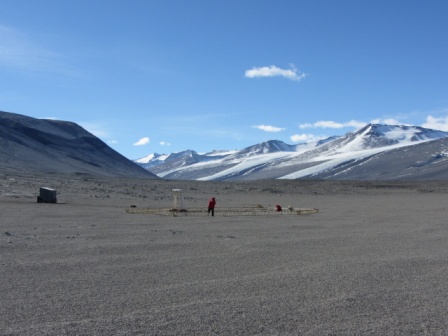
As its name implies, one of the driest and weirdest locales in a very weird continent is the McMurdo Dry Valleys. This area near the coast is the biggest chunk of Antarctica not covered by ice. Bare rock is found there, and not a whole lot else.
There is, however, an unusual feature known as Blood Falls. At the end of Taylor Glacier, which spills into one of the Dry Valleys (Taylor Valley, actually), a mysterious red trickle of salty, iron-rich water periodically stains the ice as it spills out like blood from a wound. It’s a good thing that it isn’t a paranormal message from ghosts warning researchers to leave the valley, because it has had the opposite effect—it draws them in. In 2012, for example, biologists looking for signs of life eking out an existence in the Dry Valleys discovered that Blood Falls contained an impressive community of microbial life.
You might also like


It is thought that the weight of the glacial ice is squeezing these periodic flows out of the sediment beneath, but the bigger question is what that water is doing there in the first place. It’s cold enough in this area that Taylor Glacier should be frozen to its bed—which ought to be made of frozen sediment. But that assumes fresh water. The Blood Falls water is salty enough to stay liquid down to -6 degrees Celsius at surface pressure (and could go lower at higher pressure). So where is this briny water coming from?
To learn more, a group led by University of Tennessee, Knoxville microbiologist Jill Mikucki flew a giant electromagnetic transmitter up Taylor Valley. The huge loop induces an eddy current that penetrates below ground, and a smaller pick-up coil measures the decay of the resultant magnetic field. That produces measurements of electrical resistivity, which differs between ice, freshwater, and salty water.