Customs Today
  • Home
  • Islamabad
  • Karachi
  • Lahore
  • National
  • Transfers and Postings
  • Chambers & Associations
  • Business
No Result
View All Result
Customs Today
  • Home
  • Islamabad
  • Karachi
  • Lahore
  • National
  • Transfers and Postings
  • Chambers & Associations
  • Business
No Result
View All Result
Customs Today
No Result
View All Result
Home Science & Technology Science

Study exposes new details on matters that make up the Universe

byCT Report
07/12/2015
in Science, Science & Technology
Share on FacebookShare on Twitter

HONG KONG: Matter as we know it – or that which composes everything known – is a mere 5 percent of the great and mighty universe, and about half of that is still undetected.

Researchers from the University of Geneva and the Ecole polytechnique fédérale de Lausanne (EPFL) found that a major part of the ordinary matter unaccounted for is in a really hot gas form linked to intergalactic filaments.


You might also like

Tesla driverless system to use updated radar technology

12/09/2016

Apple to develop its own self-driving technology

10/09/2016

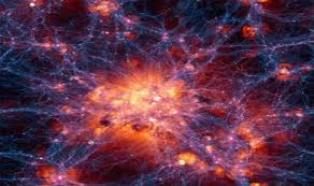
Writing in the journal Nature and using numerical simulations, they observed that it is possible to forecast that the rest of this ordinary matter should be found in the massive structures forming the “cosmic web” at 100,000 to 10 million degree temperatures.

As galaxies form after ordinary matter breaks down and cools down, the team sought to understand the start of this formation through knowing where and in what specific form “missing baryons” – ordinary matter remaining unperceived – are found.

They looked at the massive galaxy cluster Abell 2744 through the XMM space telescope, which can detect very hot gases due to its X-ray sensitivity.

The findings showed that the universe’s ordinary matter is not homogenously distributed – instead, it is determined by gravity, and that it assumes a kind of filamentary network dubbed as “cosmic web.”

Researchers aimed the space telescope at the predicted locations of these filaments, measuring the temperature and density of objects found in the region. What they found was aligned with their numerical simulations’ predictions: 10-million-degree hot gas structures come with these filaments.


Related Stories

Tesla driverless system to use updated radar technology

byCT Report
12/09/2016

WASHINGTON: Electric carmaker Tesla announced Sunday it was upgrading its Autopilot software to use more advanced radar technology. In a...

Apple to develop its own self-driving technology

byCT Report
10/09/2016

SAN FRANCISCO: Apple may not become an automaker, but it still wants to develop its own self-driving technology. The iPhone-maker's...

NASA spots slowest known magnetar

byCT Report
10/09/2016

WASHINGTON: Astronomers have found evidence of a magnetar - magnetised neutron star - that spins much slower than the slowest...

‘YouTubers’ outshining old-school television

byCT Report
09/08/2016

SAN FRANCISCO: A media revolution is taking place, and most people over 35 years of age aren’t tuned in. Millennial...

Next Post

Researchers unveil secrets of Aussie 'resurrection' grass

  • Terms and Conditions
  • Disclaimer

© 2011 Customs Today -World's first newspaper on customs. Customs Today.

No Result
View All Result
  • Transfers and Postings
  • Latest News
  • Karachi
  • Islamabad
  • Lahore
  • National
  • Chambers & Associations
  • Business
  • About Us

© 2011 Customs Today -World's first newspaper on customs. Customs Today.