You might also like


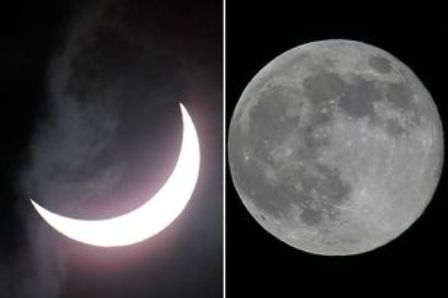
PARIS: Sky-gazers will be in for a celestial treat before the Spring Equinox, as the deepest solar eclipse since 1999 and a Supermoon will fall on two consecutive days – a phenomenon known as a Supermoon eclipse
On 20 March, parts of the UK will be gradually plunged into darkness when the moon lines across the sun, obscuring by blocking 98 per cent of its light in the most northern parts of the Earth. In other areas, the sun will be obscured by around 30 per cent.
Although partial solar eclipses happened in 2006, 2008 and 2011, this will be the biggest since 1999.
The next one will be in 2018, but we will have to wait until 2026 for another deep solar eclipse, and until 2090 for one rivalling 1999.
And the day before the eclipse, the Earth and Moon will be as close together as they possibly can be, giving rise to a so-called Supermoon.
The phenomenon occurs because of the oval shape of its orbit and its elliptical path around Earth.
When in perigee, the moon is around 50,000 km closer than when it is furthest away, or in apogee.
On 19 March, the moon will become full on the same day it is in perigee, and appear in the sky as an enormous, glowing orb.
Unlike solar eclipses and other celestial treats, supermoons occur every 13 months and 18 days.