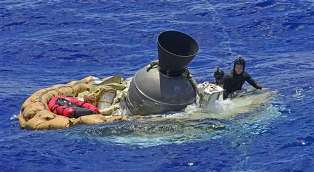


HONG KONG: NASA scientists working toward putting people on Mars said Tuesday a supersonic parachute they are developing to slow a vehicle’s approach to the Red Planet partially deployed in a test, but immediately ripped apart.
The 100-foot-wide (30-meter) chute was sent into Earth’s upper atmosphere aboard a sort of “flying saucer” test vehicle that was hoisted to the heavens via a giant balloon lifting off from Hawaii on Monday. It was the second such test of the enormous parachute, the largest supersonic chute ever deployed, which is being designed to slow the three-ton test craft as it travels at more than twice the speed of sound.
During the first experiment a year ago, the parachute was torn to shreds as it opened, destroyed by the massive drag generated by super-fast air speeds. NASA engineers said Tuesday that the parachute in the latest test had fared little better, and ripped apart as it became fully unfurled.
“Preliminary analysis of imagery and other data received during the test indicates the Supersonic Ringsail parachute deployed,” NASA said in a statement.
“The chute began to generate large amounts of drag and a tear appeared in the canopy at about the time it was fully inflated.” The test involved sending the flying saucer, an inner-tube shaped decelerator and the parachute to an altitude of 120,000 feet over the Pacific Ocean with the help of the giant balloon.
The saucer is called the Low-Density Supersonic Decelerator (LDSD). Rockets lifted the vehicle even higher, to 180,000 feet, pushing it to supersonic speeds. Ian Clark, the project’s principal investigator at NASA’s Jet Propulsion Laboratory (JPL) in Pasadena, California said the latest test was at least partially successful.

Karachi Port sets 138-year cargo handling record
KARACHI: Pakistan's maritime sector has achieved a major milestone as Karachi Port set a new record in its 138-year history...