Customs Today
  • Home
  • Islamabad
  • Karachi
  • Lahore
  • National
  • Transfers and Postings
  • Chambers & Associations
  • Business
No Result
View All Result
Customs Today
  • Home
  • Islamabad
  • Karachi
  • Lahore
  • National
  • Transfers and Postings
  • Chambers & Associations
  • Business
No Result
View All Result
Customs Today
No Result
View All Result
Home Science & Technology Science

Termite dirt mounds are necessary to save desertification: study

byCustoms Today Report
09/02/2015
in Science, Science & Technology
Share on FacebookShare on Twitter

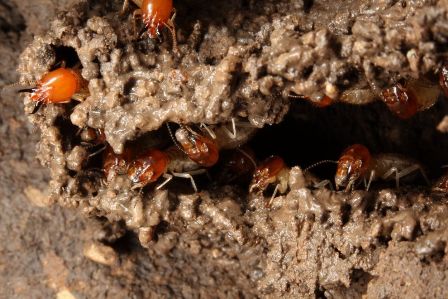
HOLON: According to a recent study, termites could prove helpful in halting the spread of deserts into semi-arid ecosystems. New discoveries propose termites make sizable dirt mounds that make certain regions flexible to the negative impacts of climate change by serving as reservoirs of moisture.

The “pests” slow the spread of deserts by providing a moist refuge for vegetation on and around their mounds. “This study demonstrates that termite mounds create important refugia for plants and help to protect vast landscapes in Africa from the effects of drought,” said Doug Levey, programme director in the National Science Foundation’s Division of Environmental Biology, which funded the research.


You might also like

Tesla driverless system to use updated radar technology

12/09/2016

Apple to develop its own self-driving technology

10/09/2016

Nutrients as well as moisture are stored in termite mounds via internal tunnels that allow sparse water to penetrate the soil in a better way.

Researchers found that vegetation grew more easily in areas that surround the mounds. The study says that these mounds contribute to recovery after periods of drought because dormant seeds remain protected in the mounds.

“Even when you get to such harsh conditions where vegetation disappears from the mounds, re-vegetation is still easier,” co-author Cornia Tarnita explained in a statement.

The research studied the fungus-growing termite species, Odontotermes, but the results apply to all types of termites. Corresponding author Corina Tarnita, a Princeton University ecologist and evolutionary biologist, said that termite mounds also preserve seeds and plant life, which sprout to life when it rains.

“Exactly what each type of animal does for vegetation is hard to know in advance,” he said. “You’d have to get into a system and determine what is building the mounds and what the properties of the mounds are.”

The group concocted a scientific model that looked at the beneficial properties of the termite mounds. Portraying the eusocial insect as the “linchpins” of plant development, the group found that the mounds were in charge of modifying the characteristics of the soil and aerating the ground.


Tags: Africa from the effects of droughtCornia TarnitaDoug LeveyEnvironmental BiologyNational Science Foundation's Divisionnecessary to save DesertificationTermite dirt mounds

Related Stories

Tesla driverless system to use updated radar technology

byCT Report
12/09/2016

WASHINGTON: Electric carmaker Tesla announced Sunday it was upgrading its Autopilot software to use more advanced radar technology. In a...

Apple to develop its own self-driving technology

byCT Report
10/09/2016

SAN FRANCISCO: Apple may not become an automaker, but it still wants to develop its own self-driving technology. The iPhone-maker's...

NASA spots slowest known magnetar

byCT Report
10/09/2016

WASHINGTON: Astronomers have found evidence of a magnetar - magnetised neutron star - that spins much slower than the slowest...

‘YouTubers’ outshining old-school television

byCT Report
09/08/2016

SAN FRANCISCO: A media revolution is taking place, and most people over 35 years of age aren’t tuned in. Millennial...

Next Post

Indonesia’s Kadin expects govt to work on port infrastructure

  • Terms and Conditions
  • Disclaimer

© 2011 Customs Today -World's first newspaper on customs. Customs Today.

No Result
View All Result
  • Transfers and Postings
  • Latest News
  • Karachi
  • Islamabad
  • Lahore
  • National
  • Chambers & Associations
  • Business
  • About Us

© 2011 Customs Today -World's first newspaper on customs. Customs Today.