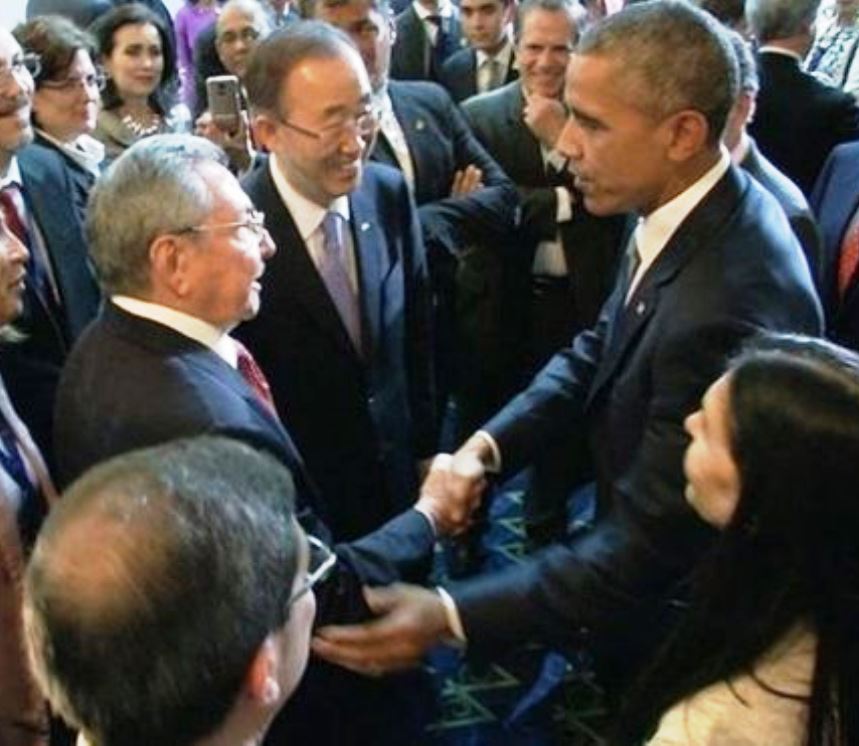
HAVANA: There is a new entry among Cuba’s roll of important dates. Alongside Fidel Castro’s 26th of July movement and the January 1 1959 “triumph of the revolution”, there is now December 17 2014.
That was the day when Barack Obama and Raúl Castro, the US and Cuban presidents, announced that they wanted to normalise bilateral relations and end more than 50 years of cold war enmity.


To be sure, communist Cuba was already changing. After formally becoming president in 2008, Mr Castro began a tentative economic liberalisation process to boost the country’s flagging economy — especially urgent now that Venezuela’s growing crisis jeopardises the $1.5bn of aid it sends every year.
But the December 17 announcement lit a bonfire of expectations among US businesses — even if Cuba’s $80bn economy, for all its exotic allure, is much the same size as the Dominican Republic’s.
“There is a new sense of excitement, of US companies coming to look and thinking of starting seed businesses,” says one long-established European investor in Havana. “It makes sense. Start small, learn how the system works and then see how it all goes.”
So, how might it all go? US and Cuban officials have warned that expectations are too high. “Prospects [in Washington] for lifting the embargo in the short term are dim,” cautions Michael Shifter of the Inter-American Dialogue think-tank.
The notion that US businesses and tourists might soon turn Cuba into a Disney-style communist theme park with McDonald’s outlets spread along Havana’s seafront is also unlikely; Havana has run its own government for 56 years and is proud of its sovereignty.
Furthermore, even if the US embargo were to end overnight, the island still faces an “internal embargo” — the thicket of Soviet-style bureaucracy and centralising socialist attitudes that makes doing business difficult.
“All of Raúl’s economic reforms involved decentralisation, which is good, as Cuba needs that,” says Rafael Hernández, editor of Temas, a state-published cultural magazine. “The problem is this has not happened.”
Still, change is coming to Cuba, however slowly, and one way to mark the changes is to travel back to Pope John Paul II’s 1998 visit. “Do not be afraid,” he said. “May Cuba, with all its magnificent potential, open itself to the world, and may the world open itself to Cuba.”
Today, Cubans appear less afraid. Activists are still hounded, but there is a willingness among many to speak their minds, and some official tolerance too.
One sign of this is the continued existence of news website 14ymedio.com, set up by dissident journalist Yoani Sánchez — even if limited internet access means few of Cuba’s 11m people can read it.
The world has also begun to open up to Cuba. Before December 17, there were only 35 enquiries from foreign investors about Mariel — the $800m port and free trade zone on Cuba’s northern coast, built by Odebrecht, a Brazilian construction company, and operated by Singapore’s PSA. “After December 17, there is talk of 300 enquiries,” notes Emilio Morales of the Miami-based Havana Consulting Group — although how many of these enquiries turn into actual investment is another matter.
The embargo, whose removal requires settling tricky issues such as $7bn of US nationalisation claims, puts a brake on US businesses. It can also put a brake on third-country businesses, too.
“We have to be entirely self-financed,” comments one European resort operator. “The new US approach has been ‘that may be no longer illegal, but it is not necessarily legal either’ — which makes financing problematic.”
Lastly, Cuba is opening to the world, albeit slowly. The Communist party is torn between letting reforms rip and maintaining control. Little surprise that results are disappointing — as was tacitly recognised by Mr Castro, who wants to deepen reforms, increasing the chances of an economic “soft landing” in 2018, when he says he will retire as president.
“Dealing with the internal embargo is one of Cuba’s biggest challenges,” says Pedro Freyre of US law firm Akerman. “The state might want to let small businesses grow . . . but then it often taxes, regulates and clobbers them.” One sign of ambivalence is the emphasis on state-sanctioned co-operatives, rather than the 500,000 self-employed workers.