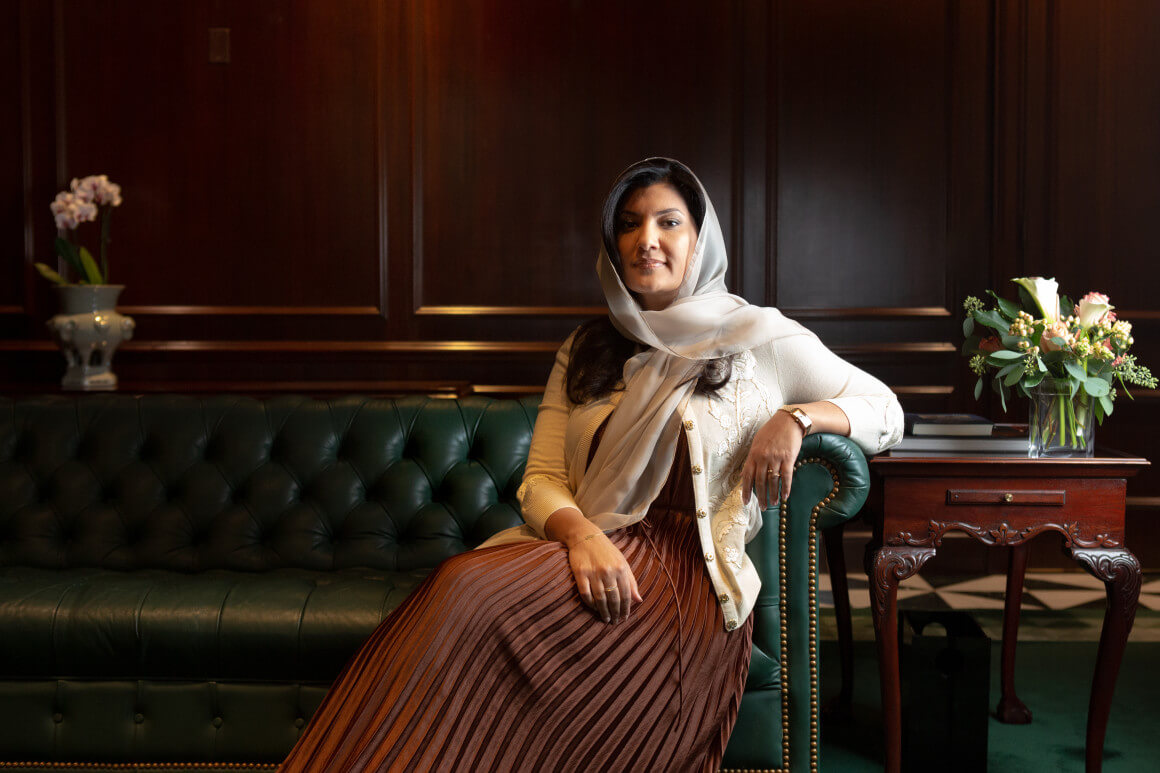
On a hot Friday morning in early August, the sound of giggles and whispers permeated the usually uninviting lobby of the Saudi Arabian Embassy in Washington, as some 50 female embassy employees gathered in the ballroom to meet their new boss. Princess Reema bint Bandar Al Saud, Saudi Arabia’s ambassador to the United States, had been in Washington for only a few weeks, and this was her first group meeting of embassy staff—but only the women. The room was hushed as she entered, in pants and a black and white jacket, without the customary headscarf worn in male company. She stopped short of the podium and sat on a set of steps, eye to eye with her employees.
Earlier that day, the Saudi government had announced it was relaxing the country’s so-called guardianship system, a mixture of laws and customs requiring women to get permission from men in their families to make all manner of personal decisions. The ambassador talked the women through their new rights, including obtaining passports and traveling abroad, registering marriages, filing for divorce and serving as legal guardians for children. Despite her royal status, the princess explained that, as a divorced mother, she was only now the head of her own household.


“You have unalienable rights now,” she told the women. “The right to your own identity, to move, dream, work.” But the new freedoms, she cautioned, came with new responsibilities. “Know where your money is,” she told them. Be “gracious” to Saudi men, who have no user manual to navigate this new world. “We are going to have to have a very emotional learning curve on what we are now allowed to do,” she said.
It was a historic moment, both for Saudi Arabia and for its embassy: Princess Reema is now the first woman to serve as Saudi ambassador to any country. She was already something of a celebrity back home in Riyadh, having agitated for Saudi women to enjoy the same rights and freedoms she experienced growing up in Washington, where her father, Prince Bandar bin Sultan, served as ambassador from 1983 to 2005. Now, many Saudis see her as a symbol to the United States of Crown Prince Mohammed bin Salman’s ambitious plan to modernize Saudi society and a personification of the new possibilities available to Saudi women.
Yet it is unclear how much even a reform-minded, U.S.-raised daughter of a diplomat can do for the Saudis in Washington right now: Princess Reema, 44, arrives at a time of deep distrust between the United States and Saudi Arabia—and, in particular, the crown prince, who is considered the power behind the throne of his father, King Salman. The Saudi-led war in Yemen, the government’s detention of activists and dissenters, and the U.S. intelligence community’s assessment that the crown prince himself ordered the brutal killing of Washington Post columnist Jamal Khashoggi have left official Washington perhaps more skeptical than ever of the U.S. alliance with Riyadh.
“She is stepping into this job when it is probably the toughest time for a Saudi ambassador,” says Elisa Massimino, the former CEO of Human Rights First and now a professor at Georgetown Law Center. “It’s not just because of Khashoggi, but a bipartisan effort to recalibrate the entire U.S.-Saudi relationship.”
In her first interview since arriving in Washington, the ambassador was well aware that neither her résumé nor her history of advocacy on behalf of women will easily change the perception among Saudi Arabia’s critics that her appointment is simply a public relations stunt to distract from widespread concerns over the crown prince, also known as MBS.
“Everyone has the right to their own opinion, and I would like to be judged on the quality of my work,” she told me in September, in her spacious top floor office. “I am not here with bubble wrap, and I would be offended if I was treated with kid gloves.”
She likely won’t be. While the princess might be a revolutionary in some respects, she represents—and fiercely defends—a regime that many in Washington associate more closely with horrific human rights abuses. The ambassador, in spite of her own record of pushing for women’s rights, downplays MBS’ detention of several dozen women activists. She also told me she “never had a shadow of a doubt” about the crown prince’s professed innocence in the Khashoggi death, in spite of the CIA’s conclusion to the contrary. (In a pair of recent television interviews marking the one-year anniversary of the murder, MBS took responsibility, as Saudi Arabia’s de facto ruler, but continued to deny being personally involved.)