Customs Today
  • Home
  • Islamabad
  • Karachi
  • Lahore
  • National
  • Transfers and Postings
  • Chambers & Associations
  • Business
No Result
View All Result
Customs Today
  • Home
  • Islamabad
  • Karachi
  • Lahore
  • National
  • Transfers and Postings
  • Chambers & Associations
  • Business
No Result
View All Result
Customs Today
No Result
View All Result
Home Science & Technology Science

Tractor beam that uses high-amplitude sound waves to levitate, move developed

byCustoms Today Report
30/10/2015
in Science, Science & Technology
Share on FacebookShare on Twitter

LONDON: The tractor beam, a staple of science fiction including “Star Wars” and “Star Trek” that is employed to grab spaceships and other things remotely, is entering the realm of reality.

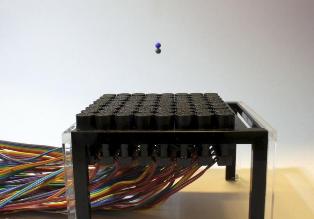
Researchers on Tuesday said they have developed a tractor beam that uses high-amplitude sound waves to levitate, move and rotate small objects without making contact with them. They envisioned medical and other applications for the device.


You might also like

Tesla driverless system to use updated radar technology

12/09/2016

Apple to develop its own self-driving technology

10/09/2016

“As a mechanical wave, sound can exert significant forces on objects. Just remember the last time you were in a concert and your chest was vibrating with the music,” said study lead author Asier Marzo of Britain’s University of Bristol and Spain’s Public University of Navarre.

Marzo said this sonic tractor beam has manipulated objects up to about one-seventh of an inch (4 mm) in diameter and can control the position and orientation of the levitated objects.

The tractor beam uses ultrasound at a frequency of 40 kilohertz. People can hear only below 20 kilohertz.

The researchers used sound waves from 64 miniature loudspeakers called transducers to create what they called “acoustic holograms” to control an object without touching it. These waves took the form of tweezers to lift an object, a vortex to hold a levitating object in place and a cage to surrounds an object and hold it in place.

“A simple wave will just push the particle in the direction of propagation. However, multiple waves will interfere with each other and create complex, acoustic 3D shapes that exert forces from all directions and keep the particle in place,” Marzo said.

Marzo said the largest object moved using the device was a 4 mm bead made of a light plastic called polystyrene.


Related Stories

Tesla driverless system to use updated radar technology

byCT Report
12/09/2016

WASHINGTON: Electric carmaker Tesla announced Sunday it was upgrading its Autopilot software to use more advanced radar technology. In a...

Apple to develop its own self-driving technology

byCT Report
10/09/2016

SAN FRANCISCO: Apple may not become an automaker, but it still wants to develop its own self-driving technology. The iPhone-maker's...

NASA spots slowest known magnetar

byCT Report
10/09/2016

WASHINGTON: Astronomers have found evidence of a magnetar - magnetised neutron star - that spins much slower than the slowest...

‘YouTubers’ outshining old-school television

byCT Report
09/08/2016

SAN FRANCISCO: A media revolution is taking place, and most people over 35 years of age aren’t tuned in. Millennial...

Next Post

Kenyans access financial services increase 14% between 2013-2015

  • Terms and Conditions
  • Disclaimer

© 2011 Customs Today -World's first newspaper on customs. Customs Today.

No Result
View All Result
  • Transfers and Postings
  • Latest News
  • Karachi
  • Islamabad
  • Lahore
  • National
  • Chambers & Associations
  • Business
  • About Us

© 2011 Customs Today -World's first newspaper on customs. Customs Today.