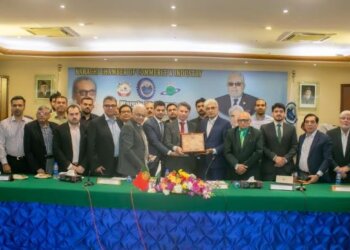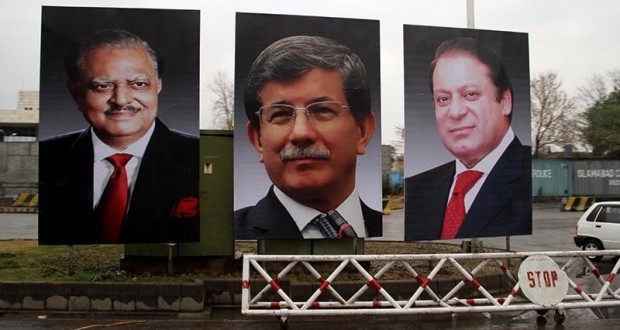
LAHORE: Lahore Chamber of Commcerce and Industry (LCCI) President Ijaz A Mumtaz, who had signed an MoU with his Turkish counterpart in the presence of Turkish Primer Ahmet Davutoglu and PM Nawaz Sharif, has said that Turkey is a time-tested friend and can play an important role in economic turnaround of Pakistan.
The LCCI president said that ample opportunities existed in a number of sectors including construction and energy sectors of Pakistan and now it was duty of the policy-makers to make this visit meaningful. He said that Turkey for being second fastest growing economy of the world after China and first in the European Union had a lot to offer to their Pakistani counterparts and they should avail the opportunities.
Both the countries had marvellous untapped business potential that needed to be realised by maximizing the involvement of private sectors, he added.
Ijaz said that textile sector had traditionally been the biggest sector of Pak economy, as the studies and surveys confirmed that its contribution in total exports were almost 60 percent and it engaged almost 38 percent of manufacturing labour force to acquire more than 46 percent share in overall manufacturing.
The LCCI President said that in the context of having won the GSP Plus status, the need of technology improvement and capacity building in textile sector of Pakistan was necessary.
No other country could become better partner with Pakistan than Turkey, therefore, any initiative from Turkish business community would always be welcomed.
Ijaz said that Turkey was well positioned to take advantage of Pakistan’s economic potential and its geo-strategic location.
With regard to solid waste management, he said, it was proposed that waste-to-energy solutions were gaining a lot of success in modern world, asserting that Pakistan was facing severe crisis in energy sector and it was the best way to go for all possible options of alternative energy.
He said that some analysts presumed that trade volume between Turkey and Pakistan could be increased as high as $ 2 billion with some joint efforts made by public and private sectors of both the countries.