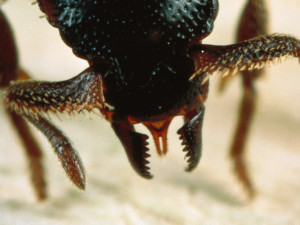
NEW YORK: Trap-jaw ants have an amazing weapon: their mouth. Their spring-loaded jaws are capable of snapping shut as fast as 60 meters/second (134 miles/hr) and can generate forces over 300 times their body weight. These ants are ferocious predators of termites and other small insects with their lethal jaw snap. Trap-jaw ants also can catapult themselves into the air with a jaw snap:
Aside from being really neat to watch, why might ants that are so formidably protected with powerful jaws use them in such a strange way? Is it just a byproduct of robust jaws that they occasionally send themselves flying ass over teakettle?


Jaws that snap shut with extreme force can have both an offensive and defensive function. The jaws can toss an opponent away during a fight; and when under attack, a colony of ants fling themselves around like popping popcorn, disorienting attackers.
New research looked at how the jaws might function against a predator of ants: antlions. Antlions are, as you might infer from the name, a type of insect that preys upon ants. Antlions build lairs in the sand and wait for an ant or another insect to tumble in. The antlion grabs its victim with large, menacing jaws, pulls it under the sand, and injects digestive fluids into the prey’s body cavity.
If you think this sounds a bit like a Star Wars saarlac, a Tremors graboid, or the Ceti eel that got put into Chekov’s ear, you aren’t wrong. All of those were inspired by antlions. It is a worthy adversary for a trap-jaw ant.
Antlions fling grains of sand at their victims to make their pit walls less stable, and hurry their slide to doom