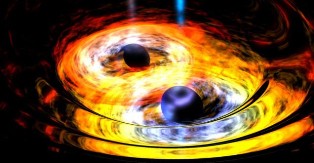


EUROPE: A recent study providing a new support for the converging black holes in the Virgo constellation has suggested that the crash is expected to take place in 100,000 years, far sooner than previously predicted. Earlier this year, astronomers discovered what appeared to be a pair of supermassive black holes circling toward a collision so powerful it would send a burst of gravitational waves surging through the fabric of space-time itself.
Now, astronomers at Columbia University provide additional evidence that a pair of closely orbiting black holes is causing the rhythmic flashes of light coming from quasar PG 1302-102.
Based on calculations of the pair’s mass–together, and relative to each other–the researchers go on to predict a smashup 100,000 years from now, an impossibly long time to humans but the blink of an eye to a star or black hole.
Spiraling together 3.5 billion light-years away, deep in the Virgo constellation, the pair is separated by a mere light-week. By contrast, the closest previously confirmed black hole pair is separated by 20 light-years.
Senior author, Zoltan Haiman said that this is the closest researchers have come to observing two black holes on their way to a massive collision, adding that watching this process reach its culmination can tell them whether black holes and galaxies grow at the same rate, and ultimately test a fundamental property of space-time: its ability to carry vibrations called gravitationl waves, produced in the last, most violent, stage of the merger.

Karachi Port sets 138-year cargo handling record
KARACHI: Pakistan's maritime sector has achieved a major milestone as Karachi Port set a new record in its 138-year history...