LONDON: Scientists hope that new genetic letters, created in the lab, will endow DNA with new powers.
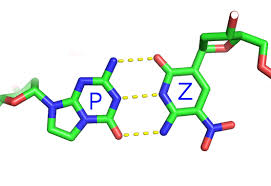
The two new letters are named P and Z, and fit seamlessly into existing DNA.


DNA stores our genetic code in an elegant double helix. But some argue that this elegance is overrated. “DNA as a molecule has many things wrong with it,” said Steven Benner, an organic chemist at the Foundation for Applied Molecular Evolution in Florida.
Nearly 30 years ago, Benner sketched out better versions of both DNA and its chemical cousin RNA, adding new letters and other additions that would expand their repertoire of chemical feats. He wondered why these improvements haven’t occurred in living creatures. Nature has written the entire language of life using just four chemical letters: G, C, A and T. Did our genetic code settle on these four nucleotides for a reason? Or was this system one of many possibilities, selected by simple chance? Perhaps expanding the code could make it better.
Benner’s early attempts at synthesizing new chemical letters failed. But with each false start, his team learned more about what makes a good nucleotide and gained a better understanding of the precise molecular details that make DNA and RNA work. The researchers’ efforts progressed slowly, as they had to design new tools to manipulate the extended alphabet they were building. “We have had to re-create, for our artificially designed DNA, all of the molecular biology that evolution took 4 billion years to create for natural DNA,” Benner said.
Now, after decades of work, Benner’s team has synthesized artificially enhanced DNA that functions much like ordinary DNA, if not better. In two papers published in the Journal of the American Chemical Society last month, the researchers have shown that two synthetic nucleotides called P and Z fit seamlessly into DNA’s helical structure, maintaining the natural shape of DNA. Moreover, DNA sequences incorporating these letters can evolve just like traditional DNA, a first for an expanded genetic alphabet.
The new nucleotides even outperform their natural counterparts. When challenged to evolve a segment that selectively binds to cancer cells, DNA sequences using P and Z did better than those without.
“When you compare the four-nucleotide and six-nucleotide alphabet, the six-nucleotide version seems to have won out,” said Andrew Ellington, a biochemist at the University of Texas, Austin, who was not involved in the study.
Benner has lofty goals for his synthetic molecules. He wants to create an alternative genetic system in which proteins — intricately folded molecules that perform essential biological functions — areunnecessary. Perhaps, Benner proposes, instead of our standard three-component system of DNA, RNA and proteins, life on other planets evolved with just two.