

Customs Today
  • Home
  • Islamabad
  • Karachi
  • Lahore
  • National
  • Transfers and Postings
  • Chambers & Associations
  • Business
No Result
View All Result
Customs Today
  • Home
  • Islamabad
  • Karachi
  • Lahore
  • National
  • Transfers and Postings
  • Chambers & Associations
  • Business
No Result
View All Result
Customs Today
No Result
View All Result

Underground Ocean on Jupiter’s largest moon

bySana Anwar
18/03/2015
in Uncategorized
Share on FacebookShare on Twitter

You might also like

Pakistan faces mango export challenges amid Afghanistan border closure, Gulf tensions

13/05/2026

Qatari LNG tanker heads via Strait of Hormuz to Pakistan, shows data

13/05/2026

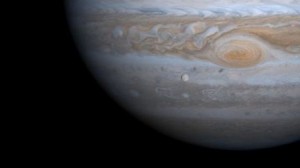
CANADA: Astronomers have found the most conclusive evidence yet that a large watery ocean lies beneath the surface of Jupiter’s moon Ganymede.
Scientists have suspected for decades that a subterranean ocean might slosh between the rocky mantle and icy crust of the largest moon in our solar system, but they had not been able to prove it definitively until now.
Using the Hubble Telescope, a team of researchers has detected slight fluctuations in two bands of glowing auroras in Ganymede’s atmosphere that they say could occur only if the moon contained a salty body of water.
“The Solar System is now looking like a pretty soggy place,” said Jim Green, director of planetary science at NASA. “The more we look at individual moons, the more we see that water is really in enormous abundance.”
Ganymede is the only moon in the Solar System that has its own magnetic field. However, it is also affected by the magnetic field of Jupiter, the giant planet next door.
The effect of Jupiter’s magnetic field on Ganymede changes every 10 hours, which is the length of time it takes the planet to make a full rotation on its axis. For five hours its magnetic field points toward Ganymede, then for another five hours it points away.
“It’s like a lighthouse,” said Joachim Saur of the University of Cologne in Germany, who led the research.
Saur figured that these regular shifts in Jupiter’s magnetic field would affect the position of the auroras in Ganymede’s atmosphere differently depending on whether or not the moon has a subsurface ocean.

Related Stories

Pakistan faces mango export challenges amid Afghanistan border closure, Gulf tensions

byCT Report
13/05/2026

ISLAMABAD: Pakistan mango export sector is facing mounting challenges due to geopolitical tensions in Afghanistan and the Middle East, threatening...

Qatari LNG tanker heads via Strait of Hormuz to Pakistan, shows data

byCT Report
13/05/2026

KARACHI: A second Qatari liquefied natural gas tanker is transiting the Strait of Hormuz days after the first such cargo...

RCCI inks MoU with China’s IBI Group to promote industrial cooperation

byCT Report
13/05/2026

RAWALPINDI: The Rawalpindi Chamber of Commerce & Industry (RCCI) signed a Memorandum of Understanding (MoU) with China’s IBI Group during...

Pakistan weighs fertiliser imports from Central Asia amid fears of supply disruptions

byCT Report
13/05/2026

ISLAMABAD: Prime Minister Shehbaz Sharif directed the authorities to ensure timely provision of fertiliser to farmers at all costs and...

Next Post

Australian stocks set to open lower, S&P 200 dips 11.4pts

  • Terms and Conditions
  • Disclaimer

© 2011 Customs Today -World's first newspaper on customs. Customs Today.

No Result
View All Result
  • Transfers and Postings
  • Latest News
  • Karachi
  • Islamabad
  • Lahore
  • National
  • Chambers & Associations
  • Business
  • About Us

© 2011 Customs Today -World's first newspaper on customs. Customs Today.