Customs Today
  • Home
  • Islamabad
  • Karachi
  • Lahore
  • National
  • Transfers and Postings
  • Chambers & Associations
  • Business
No Result
View All Result
Customs Today
  • Home
  • Islamabad
  • Karachi
  • Lahore
  • National
  • Transfers and Postings
  • Chambers & Associations
  • Business
No Result
View All Result
Customs Today
No Result
View All Result
Home Science & Technology Science

Universe has a ‘resolution limit’ that governs how far telescopes can see, scientists

bySana Anwar
25/11/2015
in Science, Science & Technology
Share on FacebookShare on Twitter

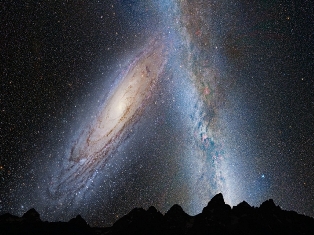
WASHINGTON: Is it possible that those distant galaxies are just too far away to ever be seen clearly? That’s the suggestion of researchers at the National Research Council of Canada, who suggest that the universe has some type of “resolution limit;” that is, a point where images of distant celestial objects will not become any clearer no matter how large the telescope is.

This is bad news for astronomers, who had hoped the 2018 launch of the James Webb Space Telescope would give a clearer view of the heavens. The Hubble Telescope experienced issues with resolution due to man-made mistakes in construction, but the limits on the James Webb telescope and future versions may be scientifically related.


You might also like

Tesla driverless system to use updated radar technology

12/09/2016

Apple to develop its own self-driving technology

10/09/2016

Think of it this way: light from distant galaxies travels extraordinary distances to reach the lenses of our telescopes. If there is anything between those galaxies and the telescope itself to disturb that light along the way, it will arrive here blurry — and no telescope is going to be able to fix that.

This may be happening in the vast space between these galaxies due to quantum mechanics. On the smallest of scales, known as the “Planck Scale,” quantum physics infers that space is filled with particles that develop and quickly destroy each other. While these reactions are very, very small, it’s enough to cause ripples in the fabric of space-time. Just like light passing through Earth’s atmosphere, the light from these distant galaxies and objects become distorted.

While this may be bad news for astronomers hoping for clearer pictures of distant celestial objects, the whole concept of quantum mechanics (and quantum physics for that matter) is still a highly controversial and debated topic. This means that such a prediction might be wrong if currently accepted theories of quantum physics are incorrect. But if it is correct, it only shows us how little we may ever know of our universe, thanks to its massive size.


Related Stories

Tesla driverless system to use updated radar technology

byCT Report
12/09/2016

WASHINGTON: Electric carmaker Tesla announced Sunday it was upgrading its Autopilot software to use more advanced radar technology. In a...

Apple to develop its own self-driving technology

byCT Report
10/09/2016

SAN FRANCISCO: Apple may not become an automaker, but it still wants to develop its own self-driving technology. The iPhone-maker's...

NASA spots slowest known magnetar

byCT Report
10/09/2016

WASHINGTON: Astronomers have found evidence of a magnetar - magnetised neutron star - that spins much slower than the slowest...

‘YouTubers’ outshining old-school television

byCT Report
09/08/2016

SAN FRANCISCO: A media revolution is taking place, and most people over 35 years of age aren’t tuned in. Millennial...

Next Post

China stocks: Shanghai Composite gains 0.9% by break

  • Terms and Conditions
  • Disclaimer

© 2011 Customs Today -World's first newspaper on customs. Customs Today.

No Result
View All Result
  • Transfers and Postings
  • Latest News
  • Karachi
  • Islamabad
  • Lahore
  • National
  • Chambers & Associations
  • Business
  • About Us

© 2011 Customs Today -World's first newspaper on customs. Customs Today.