
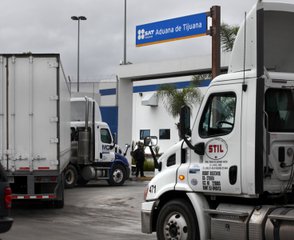
NEW YORK: In a first for the U.S.-Mexico border, customs officials from both countries expect to soon work under the same roof in Tijuana — inspecting tomatoes, strawberries, cucumbers and other Mexican produce shipments before they’re trucked into the United States.
Years in the planning, the opening of a customs pre-clearance facility is seen as a way of speeding up commercial traffic through the congested Otay Mesa Port of Entry, the second-busiest commercial port on the U.S.-Mexico border.

The final obstacle preventing implementation of the joint inspections was removed on Thursday, when Mexico’s Chamber of Deputies voted to approve changes to the country’s firearms law. Once enacted, the reforms would for the first time allow foreign immigration and customs authorities to their carry weapons when working in Mexico.
The joint inspection process, set to begin in about four months, is expected save time and money for shippers by minimizing the loading and unloading. “You see that a truck may sometimes take three hours to cross,” said José Martín García, the representative for Mexico’s Tax and Customs Administration at the Mexican Embassy in Washington, D.C. “We expect to process a truck in 25 minutes.”
Visitors to the Mexican federal facility have said it includes a laboratory, rooms for cold storage and state-of-the-art inspections equipment. The armed U.S. inspectors would enter and exit the compound directly from the United States through a secured road.
U.S. Customs and Border Protection officials declined to comment on Friday, referring questions to their Mexican counterparts.
The United States and Canadian governments have conducted joint truck cargo inspections at their countries’ shared border, but the Tijuana facility would offer the first joint inspections in Mexican territory.
Shipments cleared at the Tijuana facility would enter the Otay Mesa Port of Entry through dedicated and confined lanes. Once a truck crosses, “the U.S. reserves the right to reinspect the shipment,” García said. The idea is that only exceptional shipments would have to undergo a second examination after crossing the border.
The joint inspections would be launched under a six-month voluntary pilot program and be limited to high-volume and low-risk fruit and vegetable shipments, as defined by U.S. Customs and Border Protection’s National Agriculture Release Program. These include products grown in Baja California such as strawberries, tomatoes, cucumbers, asparagus, green onion, raspberries and blackberries.
Currently, about 225 trucks cross daily carrying such products at the Otay Mesa port, García said.
Proponents of the joint inspections said global realities are pushing such changes at borders around the world.
“If we want increased trade, we cannot continue to run that trade through highly congested ports of entry and highly inefficient ports of entry,” said Erik Lee, executive director of the North American Research Partnership. “In the United States, it is in your interest to know what’s going through your ports of entry as soon as possible, even before items arrive.”
In San Diego, the prospect of joint inspections drew applause from groups working to lessen congestion at the region’s border crossings. Paola Avila, vice president of international business affairs at the San Diego Regional Chamber of Commerce, said the new arrangement “will increase efficiency, provide greater security and reduce transaction costs.”


