NEW YORK: Customs and Border Protection officers at 10 major airports across the country will test out a new wireless handheld device that collects biometric and biographic data on foreign travelers exiting the United States in real time, according to a notice published last week in the Federal Register.
The intent of the Biometric Exit Mobile Air Test, or BE-Mobile Air Test, program, which is a follow-up to two previous so-called “air exit” pilot programs, is to use that information to verify travelers’ identities, the notice said. The program will not apply to U.S. citizens and certain other international travelers are also exempted.


In those previous tests – one conducted by CBP at Detroit Metropolitan Wayne County Airport and another conducted by the Transportation Security Administration at Hartsfield-Jackson Atlanta International Airport – federal officers also collected fingerprints using a mobile or portable device and biographic data from foreign travelers leaving the U.S.
Although the technology used in those pilot programs, which ended six years ago, worked, the Homeland Security Department concluded that the “collection mechanisms” were too resource intensive and too costly to implement so the pilots weren’t expanded or extended.
The notice said that BE-Mobile Air Test will “significantly differ” from CBP’s 2009 pilot because it will use improved technology, enable officers to receive real-time data and therefore test a different concept of operations, and will be less resource intensive, meaning the test will be conducted on fewer flights per week.
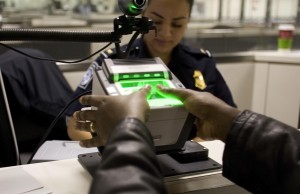
In the one-year pilot, CBP officers will position themselves near the departure gate at pre-selected random outbound international flights. Once the departure process begins, the officers will review a traveler’s passport or visa to determine if they are eligible to submit biometric information. If so, the officer will either swipe the traveler’s document into the wireless handheld device or input the data and also collect two fingerprints, according to the notice.
Based on the information collected, an officer may further analyze the data or interview a traveler. Results of all transactions will be recorded in DHS’s biometric database and a CBP biographic database in real time.
“The primary mission of any biometric exit program is to provide assurance of traveler identity on departure, giving CBP the opportunity to match the departure with a prior arrival record,” the notice said. “This capability enhances the integrity of the immigration system and the ability to accurately detect travelers that have overstayed their lawful period of admission to the United States.”
The agency will analyze and assess the test using several criteria, including watchlist matches based on biometric data, transaction times for exit processing per traveler, and the occurrence of law enforcement hits, among others.
The airports selected for the BE-Mobile Air Test program include: Hartsfield-Jackson Atlanta International Airport, Los Angeles International Airport, San Francisco International Airport, Miami International Airport, Chicago O’Hare International Airport, Newark Liberty International Airport in New Jersey, John F. Kennedy International Airport in New York, Dallas Fort Worth International Airport, Houston’s George Bush Intercontinental Airport, and Washington Dulles International Airport near Washington, D.C.