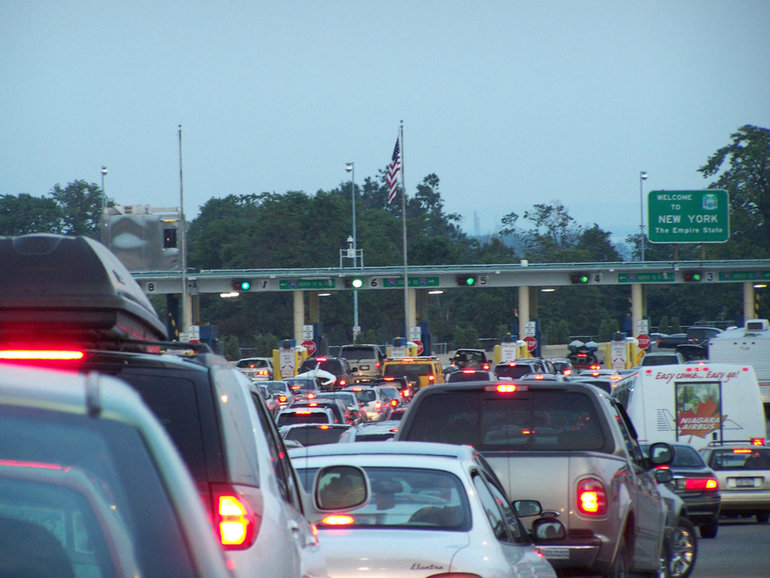
NEW YORK: US Customs and Border Protection agents admit that agency’s outdated technology can slow down truck traffic at New York’s Peace Bridge.
But the agency is working on fixing some of its tech problems, several of the agency’s top local officials said in interviews during a tour of its facilities this week. More efficient customs house and the state’s project to improve highway access to and from the bridge – should combine to prevent many of the worst traffic backups.


T he chief of Customs and Border Protection officer and the agency’s local public affairs liaison’ Aaron Bowker ‘said. There should be great improvement in the traffic flow on the plaza.”
The Customs officials spoke about the coming improvements at the Peace Bridge three weeks after The Buffalo News reported that a pilot project – in which some U.S.-bound cargo was inspected in Canada – revealed a series of low-tech issues that appeared to occasionally slow traffic at the bridge.
“This gives us a great opportunity to make improvements,” said Rose Hilmey, director of CBP’s Buffalo field office. “With some of these IT issues, we wouldn’t have known if we hadn’t done the pilot project.”
Products with low levels of naturally occurring radiation, such as kitty litter and ceramic tiles, set off alarms at the Peace Bridge, requiring trucks carrying such loads to undergo a thorough inspection. But when the more-modern radiation detection equipment is installed later this year, such harmless cargo
A pilot project is in the works that could lead to a requirement that all truckers nationwide pay their border entry fees in advance. Currently about 10 percent of truckers still pay those fees in cash rather than pre-paying, slowing up the process for everyone else.“It’s extremely important for us to automate the process totally,” Draganac said.
To that end, Customs and Border Protection also hopes to win a change in federal regulations that would require all commercial trucks crossing the border to file an electronic manifest listing their contents before crossing the border. Thanks to a current quirk in the law, trucks with cargo must file such manifests but empty trucks do not – meaning that empty trucks often require more inspection than full ones, again slowing the process unnecessarily.
While such regulatory changes never come easily, the customs agents said they were thrilled that truck inspections should proceed much more efficiently upon the completion of a new customs house at the bridge.
The new customs house, which is currently under construction and set to open in the middle of next year, will quadruple the dock space behind each truck that must be unloaded for inspection, meaning that agents can use forklifts rather than hand-operated equipment to move cargo.
That time-saving change is just one of many improvements in the new $24 million customs facility, which also includes much more secure facilities both for agents and for any wrongdoers they might apprehend.
Bowker praised his agency’s relationship with the Peace Bridge Authority, which pushed for federal government funding for the new customs house. “The key was the Peace Bridge Authority saying we need to do this,” he said.
Meanwhile, customs officials also heap praise on the State of New York’s Gateway Connections Project, a $56.2 million project to improve highway access at the bridge while restoring Front Park.
From an efficiency standpoint, customs officials are especially happy that the state project will eliminate the every-which-way traffic pattern that drivers encounter after they clear Customs, where cars and trucks cross paths in crazy and unsafe ways as they try to get to the exit to the city or the exits to the Niagara Thruway.
But once the state’s project is completed, all traffic will be funneled to one exit from the plaza rather than having to choose between three, meaning later, better-planned exits will steer them either to the city or the highway.“When the Gateway project is completed, you will see much better traffic flow,” Draganac said.
Agents, meanwhile, will soon see much better email traffic flow because of the last of the tech improvements that are set for implementation at the Peace Bridge.