
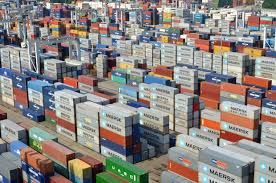
NEW YORK: The Port of Virginia, one of the nation’s largest, was built to handle high volumes of cargo traffic entering and exiting the U.S.
But on his way recently to pick up a load of bedding, Albert Newcomb was stalled for two hours before his rig could make it through a mile-long line to one of the port’s terminals. Once inside, the 43-year-old independent truck driver hit a traffic jam 13 lanes wide and 10 trucks deep. By the time he left with his load, he had waited for a total of eight hours. “It’s ridiculous,” he said, as he sat in his truck idling outside the gates. “It’s almost to the point where you want to quit.”


A key reason for the holdup: a surge of containers from three large ships at dock was straining the port’s capacity and tying up dockworkers and cranes.
Such congestion is becoming increasingly common at major U.S. ports—a problem that could have profound implications for the $900 billion worth of goods transported to and from the U.S. each year by container ships.
The slow movement of imports and exports illustrates how the logistics of global trade have fallen terribly out of sync. Ocean carriers are deploying progressively bigger vessels. Some would be taller than the Empire State Building if stood on end. They can carry more than twice as much cargo as their predecessors, and are more fuel-efficient than smaller vessels. To ensure they travel as full as possible, shipping lines have formed alliances to combine their loads.
But the floating behemoths are overwhelming many U.S. ports that weren’t built to handle such supersize ships. Of the 10 busiest U.S. ports by container volume, as calculated by the American Association of Port Authorities, at least seven are grappling regularly with congestion.
In Newark, N.J., a shortage of chassis—the undercarriages used to haul containers off the port by truck—is contributing to miles-long lines. In Los Angeles and Long Beach, the arrival of giant vessels and the growth of shipping alliances has caused terminal gridlock for months, leaving ships stuck offshore waiting to unload. That situation was exacerbated by a labor dispute at West Coast ports that was resolved in February.
The big ships “have stressed the infrastructure to the breaking point,” says Jock O’Connell, an international trade adviser at Beacon Economics LLC in Sacramento, Calif. There needs to be “a concerted effort to rethink and redesign the ports to accommodate these larger vessels and the additional cargo they’re generating,” he says.
It is only likely to get worse. Container volume at U.S. ports has increased steadily since the recession, hitting all-time highs in 2014 at many East Coast terminals. Between 2010 and 2040, the volume of the U.S.’s container trade with Northeast Asia—which accounts for the majority of the U.S.’s overall container trade—is projected to more than triple, according to a 2013 Department of Transportation study.
West Coast ports already receive megaships bearing as many as 14,000 containers traveling from Asia across the Pacific Ocean, while East Coast ones are receiving 10,000-container vessels from Asia through the Suez Canal. That volume will only grow when expansion of the Panama Canal is completed next year. The widened, deeper canal will allow ships carrying as many as 13,000 containers to travel en route to the East Coast, compared with ships hauling 5,000 containers today.
The cost of port congestion to retailers, meanwhile, is expected to climb—and ultimately be passed along to consumers.
Frank Layo, retail strategist at consulting firm Kurt Salmon, forecasts that the cumulative costs of shipping delays could reach $7 billion this year and climb as high as $37 billion in 2016. He expects some retailers to divert shipments from Asia to more-expensive routes to avoid congested West Coast ports. Consumers could “feel it in the form of mass out-of-stocks and price increases,” Mr. Layo says.
Lower fuel costs could help offset congestion costs, but whether carriers will pass along such reductions to customers is unclear, analysts say.
Audax Transportation hauls goods ranging from car engines for Ford Motor Co. to frozen chicken parts for Perdue Farms. Bottlenecks at the Port of Virginia have reduced the amount of goods its truck drivers can move in a day by 50% in the past year, says Ed O’Callaghan, the firm’s president and an agent of trucking company Century Express in Norfolk, Va. To make up for lost revenue, his company has raised prices for customers by about 35%.
“It is not enjoyable to approach shippers who have supported you over the years with such increases,” Mr. O’Callaghan says. Because congestion has limited the number of containers the company can move, Mr. O’Callaghan has had to drop some 20 clients in the past year, including a tobacco exporter and furniture importers.
Port congestion has also made it difficult for home-goods importer Hooker Furniture to gauge the staff it needs to handle the dressers, dining tables and sofas it imports from Asia, says logistics coordinator Kimberly Clark. “One day, we could be planning for 15 containers, and we may only get six” because of shipping delays, she says. Another day, a flood of containers could arrive, forcing the Martinsville, Va., company to pay workers overtime or bring in temps.
The backups have “put a lot of pressure on everybody,” says Port of Virginia spokesman Joe Harris. “We definitely regret” such situations, he adds. To alleviate congestion, the port in recent weeks has extended operating hours and added chassis and container-handling equipment.
The problem didn’t happen overnight. Investment by federal, state and local governments in U.S. ports and surrounding infrastructure—such as roads and rail lines—mostly dried up during the recession. And declining cargo volumes squeezed ports’ finances, limiting their ability to make significant investments in bigger cranes and other improvements, says John Martin, a maritime economist at Martin Associates in Lancaster, Pa.



