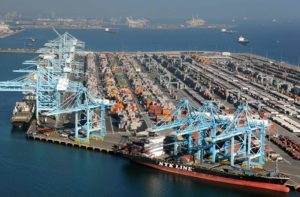
LONG BEACH: Even with government help, US ports still need more than $100 billion over the next five years to handle growing volumes and bigger ships. Private-sector investors are willing to close the gap if returns are adequate and risks are relatively low. Ports over the next five years must invest $154 billion on terminals and road and rail connectors, but can probably expect access to no more than $25 billion in public financing, said Anthony Renzi, partner, Akin Gump Strauss Hauer & Feld, who specializes in international and domestic corporate transactions. The good news is “there’s a lot of private-sector money out there,” he told the annual conference of the American Association of Port Authorities Tuesday. Federal government grants and loans historically have provided only a small percentage of ports’ capital expenditure needs, with harbor deepening being the primary beneficiary. As port-related infrastructure projects grow more expensive, the federal share will continue to shrink as a percentage of total project costs. Ports will therefore have to leverage public money to attract investments from private sources such as banks, hedge funds, retirement funds, and terminal operators that build and operate their own facilities. Infrastructure funds, teachers’ retirement funds and other private-sector investors descended upon the marine terminal market in the previous decade, often times paying multiples of projected earnings. Concerns arose that those bets were unreasonable, and the global economic recession of 2008-09 proved that the concerns were well-founded.
In the past, investment funds looked for opportunities that would generate at least a 20 percent return they could count on for about 10 years before selling out. Since the recession, investors have concentrated on terminal and infrastructure projects that offer lower, but stable returns over 20 years or longer. Private equity investors seek to mitigate risk by partnering with terminal operators that have carrier affiliates, Renzi said. With about a dozen global carriers concentrating their vessel calls at fewer but larger terminals, private equity investors seek long-term stability, relatively low risk, and guarantees of container volume, he said. The key factor in these decisions is guaranteed container volume. In an era of terminal consolidation, investors find especially attractive those projects in which they can partner with carrier-affiliated terminal operators, said. However, continued consolidation in the carrier industry will result in fewer options for ports that seek to partner with carrier-affiliated terminals. Hurwitz noted that next year, after the merger of the three Japanese-flag carriers is completed, the top 10 global shipping lines will control 84 percent of the world’s container capacity, up from 53 percent in 2006. When it comes to investing in a large terminal with a 30-year lifespan, the investment is further complicated by the nature of carrier vessel-sharing alliances, which are almost certain not to last that long, he said.


Port authorities, meanwhile, should also seek to minimize their risks when committing to building these costly terminals with long lives. Maintenance and repair costs in the rugged port infrastructure can add up, so partnering with a terminal company that builds and operates the facility will result in a better-built project, Renzi said. The effects of carrier, marine terminal and port consolidation are creating unprecedented financial demands on load-center ports. Mega-ships need mega-terminals to handle container exchanges that can easily exceed 10,000 TEU per vessel call, but many terminals were designed to handle vessels less than half the size of today’s mega-ships. Today’s terminals need taller cranes, sturdier decks, larger container yards, more efficient gate complexes and more extensive road and intermodal rail connectors in order to deliver containers efficiently to beneficial cargo owners.