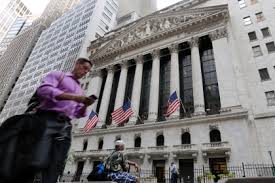
WASHINGTON: US stocks hit their sixth consecutive closing high on Thursday for the first time in more than 20 years, fuelled by signs of economic strength and renewed optimism over tax cuts. The S&P 500 closed 0.6 per cent up at 2,552.07, to mark the benchmark index’s longest such streak since June 1997, according to Thomson Reuters data. It has more than doubled in the decade since its pre-crisis peak of October 2007, and is up 350 per cent from the low it set in March 2009. President Donald Trump, whose administration has faced a string of legislative failures, was quick to note the gains, tweeting on Thursday morning: “Stock Market hits an ALL-TIME high! Unemployment lowest in 16 years! Business and manufacturing enthusiasm at highest level in decades!” Jim McDonald, chief investment strategist at Northern Trust, said: “The string of positive economic data along with absence of any negative data points has pulled any sellers out of the market.”
Investors’ mood was buoyed on Thursday by the US trade deficit narrowing and exports rebounding, which could help lift third-quarter growth. A separate report showed the number of Americans applying for unemployment benefits fell more than expected last week. On Friday investors will tune into the September jobs report for the latest snapshot on the health of the US labour market. Tech companies led the market on Thursday, adding 1.1 per cent. Netflix, a member of the so-called FAANGs — Facebook, Apple, Amazon, Netflix and Alphabet, formerly known as Google — was the biggest gainer on the S&P 500, ending the day 5.4 per cent higher at $194.39. It hit an all-time intraday high after the streaming site behind hits such as Stranger Things lifted its prices in the US and UK by as much as 17 per cent.
The S&P 500’s string of highs comes during a protracted period of low volatility. The CBOE Vix volatility index, which measures the short-term volatility implied by S&P 500 option prices, closed at 9.19, its lowest level since 1990. Financial stocks were the second-best performing sector on Thursday, gaining 1 per cent, after the Senate confirmed Randal Quarles as the Federal Reserve’s supervisory chief. Mr Quarles is expected to take a softer stance on bank regulations. The rally in US shares also came after the House of Representatives passed a 2018 budget resolution that could help Republicans bypass Democrats in pushing through tax reform. “All eyes seem focused on the prospect of US tax legislation,” said Michael Underhill, chief investment officer at Capital Innovations. “But the need for relief and reconstruction following the tragedy of three major hurricanes has superimposed a new agenda on Congress. How this may reshape the broader fiscal agenda — and the ability to get it done — is top of mind with investors so any perceived progress is moving the market upward.”