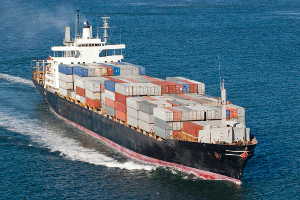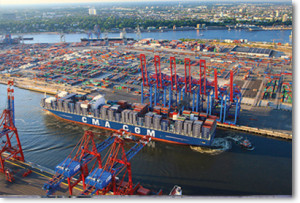

NEW YORK: Vancouver and other ports along North America’s West Coast face significant challenges in retaining and attracting a bigger share of the predicted surge in Asia Pacific container traffic over the next five years.According to Drewry, that traffic worldwide, estimated to be approximately US$4 trillion, will grow 4.5% annually through to 2019 after rising 5.4% each year from 2010 to 2014.The U.K.-based shipping consultancy predicts that Asia will account for 60% of that growth.
To handle the demand, major ocean carriers such as Maersk (Nasdaq:AMKBF) are sinking billions of dollars into adding larger container ships to their fleets and forming alliances to reap economies of scale.
According to Neil Davidson, Drewry’s ports and terminals senior analyst, the global container terminal industry is consequently facing “unprecedented” capital and operating cost challenges.Port Metro Vancouver (PMV) is also grappling with the region’s rapidly disappearing inventory of industrial land and implementation of a controversial overhaul of its container trucking system.
Solutions to those challenges need to be found soon, because, as Davidson pointed out to Business in Vancouver, container shipping is now fundamental to the global economy.
“No container shipping, no economy,” he said.
Davidson added that Drewry has not changed its forecast despite recent global economic volatility because it’s too early to “come to firm conclusions on the implications of the current issues in China.”
Ten years ago, the largest container ships could hold 9,200 20-foot equivalent units (TEUs); today that total is 19,200, enough to fill a train 77 kilometres long.
Alphaliner, an international shipping industry data company, has reported that 37 new ultra-large container ships have been deployed on the Asia-Europe trade route this year and another 13 are set to be delivered by December.While Davidson said the largest ships are assigned first to Asia-Europe trade routes, the next-largest ships are then reassigned to Asia-West Coast North America. The overall result is bigger ships on all routes.
Drewry estimates that annual container traffic outlook for West Coast North America ports will grow 2.7% through to 2019.
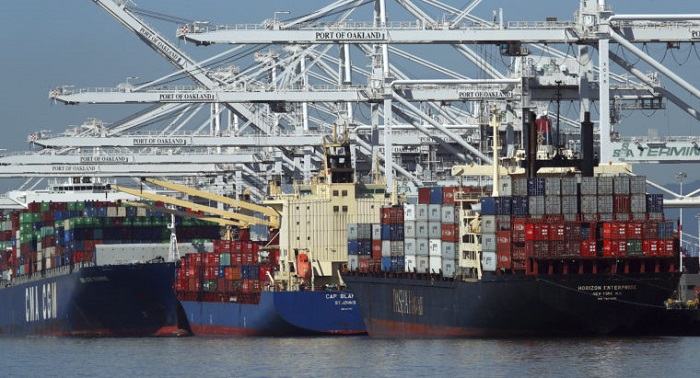
Shipping activity at Port Qasim on February 11
KARACHI: Three ships namely, Glen Canyon, Al-Salam- II and TSM Pollux carrying Containers, Gas oil and Palm oil were arranged...