You might also like


CARACAS: It has not been a dilemma for the governments of the “beautiful” revolution that took office more than 16 years ago in Venezuela to decide whether they prefer domestic production over bulk imports of everything the country demands for its survival.
Sustained oil prices above $100 per barrel for many years, together with a project for a country that goes against private sector activities, tipped the balance in favor of a cutthroat import policy in detriment of an entire national productive sector. The consequences are there for all to see: domestic production is a mess. It is already inexistent even in areas where Venezuela was self-sufficient before or was gaining strength as an exporter.
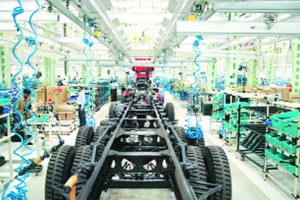
The auto sector is one of them suffering the consequences of those policies that disrupted the industrial apparatus of the country. A sector with a high labor demand and promoter of related industries generating productivity that today finds itself on the brink of survival and the closure of production lines due to the lack of foreign exchange for the import of parts and auto parts for the production and assembly of vehicles within the country, together with a set of laws restricting operations and competitiveness.
Today, the four largest automakers in Venezuela (Ford, Chrysler, General Motors and Toyota) are at risk of bringing their operations to a halt due to the lack of raw materials. For example, General Motors has reportedly sent some 2,600 workers to their homes on a forced “vacation” due to zero inventories of raw materials for the assembly of motor vehicles. From January and until August 14, the company barely assembled 4,400 units at its Valencia plant in Carabobo state (15.71% of its installed capacity of 4,000 units per month.) For its part, Ford Venezuela has no production schedule for November and December of this year, Gilberto Montoya, the secretary-general of the company’s trade union, told the press. About 500 F-350 trucks will be assembled in September, while October will see less than 30 Explorer trucks. In 2015, the company has worked at less than 20% of its full capacity. This is just to mention the situation of only two of the four automakers.
The eventual shutdown of operations of these four automakers would mean:
1) A drop of about 80% of the automotive sector production in the country.
2) The loss of some 11,000 direct jobs generated by these four automakers, and more than 100,000 indirect from related industries.
3) Hundreds of auto dealers going out of business.
Not to mention the critical situation of Rialca (previously Rualca, a manufacturer of alloy wheels expropriated by the Government in June 2008) that is barely operating at 5% of its capacity and currently producing 6,000 units per month, which means a drop of 95% with respect to the 126,000 alloy wheels per month it manufactured before passing to the hands of the State. More than half of its machinery are inoperative due to a lack of spare parts.
Therefore, it is cause for indignation the announcement of the Government that it will import from China some 20,000 vehicles to be used as taxis between this month and mid-2016. These are vehicles that could perfectly be produced in the country. What is more: the “local content” of the vehicles produced is 38%. In other words, for every $100 being spent on the import of these taxis, the country could save $38 while generating both production and employment in the vast sector of local producers of parts and components for vehicles.
And from there the rationale of the call of both employers and trade unions from the auto sector to the Government so that it stops the imports of vehicles, and that the foreign currency for said purpose is allocated to assembly lines in order to produce vehicles locally; also that restrictive policies are relaxed so that the sector can be reactivated, jobs are created and the leakage of foreign exchange is stopped.