NEW YORK: The Very Large Telescope (VLT) has given a very clear three-dimensional view of the deep universe. Hubble Space Telescope has revealed new horizons of the universe that were previously invisible.
The telescope’s MUSE instrument gathered the observations that focused on a region named the Hubble Deep Field South. Scientists use the telescopes to generate deep field images through long exposures of small regions in the sky, thus collecting data on the most distant and earliest areas of the cosmos.
In the year 1995, scientists used NASA’s Hubble Space Telescope to capture the Hubble Deep Field over a period of several days. A couple of years later, Hubble produced a similar image of the southern sky, dubbed the Hubble Deep Field South, which however, failed to show all the galaxies in the field of view.
But MUSE managed to discover those galaxies and provide additional data on the entire field of view. Following an observation period of merely 27 hours, MUSE gathered data on the distances, motions, and compositions of the galaxies in the deep field. It went on to uncover over 20 galaxies that were too distant and faint to be visible earlier.
MUSE gathered about 90,000 light spectra, which was not only used to detect objects that were unrecognized earlier, but also measure the distances to 189 galaxies in the field. Among these galaxies, some are close, while others are so far away that they were observed in their state when the Universe was less than one billion years old.
The $25 million MUSE, which took 10 years to design and build, began operating last year as part of the ESO’s VLT array based in Chile’s Atacama Desert. Hailing the results as “fantastic,” the instrument’s principal investigator Roland Bacon of France’s Lyon Centre for Astrophysics Research said, “This opens many new avenues. It shows that we have built a machine that performs extremely well and will allow us to learn many things.”
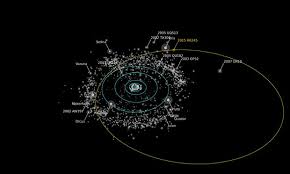
Astronomers discover distant dwarf planet beyond Neptune
LONDON: A dwarf planet half the size of Britain has been found tumbling through space in the most distant reaches...