
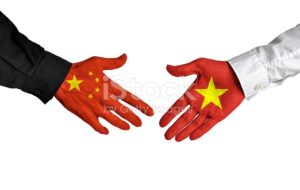
HANOI: Tensions are high on the South China Sea as Vietnam faces off against China over their overlapping maritime claims.
But for the boatmen on the junks cruising the calm expanse of Vietnam’s Ha Long Bay, another growing Chinese presence in the region is very welcome indeed.


“More than half our tourists are Chinese now,” said Nguyen Van Phu, 33, who has spent six years working on the boats that chug between the bay’s spectacular stone towers. “If they stopped coming it would be a big problem, if not a disaster.”
The number of Chinese tourists in Vietnam has surged this year, just one sign of the growing economic ties between two long-time enemies. Chinese investment in Vietnam is also increasing rapidly, as is trade between the two countries.
But while tourists, trade and investment are being welcomed, they also present a challenge for a fiercely independent country like Vietnam, which has been wary of China’s growing influence in the region.
“The rising economic dependence on China makes it more difficult for Vietnam to decide how far to confront China on the South China Sea,” said Nguyen Khac Giang, a researcher at the Vietnam Economics and Policy Research Institution.
Vietnam would suffer far more than China economically in the event of political instability given its smaller size, he said.
China exports more goods to Vietnam than any other country in Southeast Asia, sending textiles to be made into shirts and sneakers, and electronic components for mobile phones and large flat-panel displays. Those completed products are exported around the world, as well as back to China.
Vietnam also makes electronics components for factories in China, and exports computers for Chinese consumers.
Manufacturers see Vietnam as an attractive base, with wages as little as a third of those in coastal regions of China, according to employment consultants.
And while proximity has historically been a source of friction between the two countries – they fought a border war as recently as 1979 and armed clashes flared for years afterwards – for manufacturers it’s a boon.
“We strategically invested in Vietnam because of its geographical advantage – closer to China and hence lower cost on materials, transportation and relatively shorter production lead time,” said Bosco Law, chief executive of the Hong Kong-based Lawsgroup. The company makes clothes for brands such as Gap, whose global operations include scores of outlets in China.
Businesses contacted by Reuters declined to talk openly about the risks for them of tension between Vietnam and China.
Chinese trade and investment has surged across Southeast Asia in recent years as companies search out new bases for manufacturing and consumers for their goods.
China has also invested in infrastructure and plans to pour development funds into Southeast Asia as part of its sprawling Belt and Road initiative.



