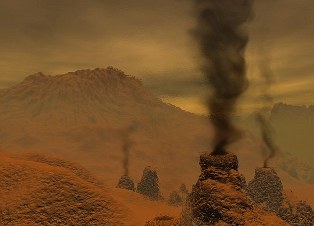


HARROW: Hidden beneath a thick atmosphere, volcanoes may still be erupting on the surface of Venus, a new study finds.
The study in the journal Geophysical Review Letters reveals that our nearest planetary neighbor could be far more active than previously thought.
Scientists often look to our neighboring planets to learn more about Earth’s past. Just next door, Mars is thought to have had water and perhaps an atmosphere thick enough to support life; tiny, sun-scorched Mercury still has a liquid outer core that powers a magnetic field, much like Earth’s.
Venus could provide insights of its own, but it’s shrouded in thick clouds of sulfuric acid that block out visible light. That’s too bad, said study co-author James Head, a planetary geoscientist at Brown University, because in many ways it would be the best planet to study to learn more about Earth and its history.
“Venus — in terms of its size, its density, position in the solar system (which is important in its formative years) — is literally the most Earth-like planet,” Head said. Russian landers in the 1970s and ’80s revealed features that looked somewhat familiar: plateaus, features that looked like mountain belts, but surprisingly few craters on the surface. The terrain indicated that the surface had been active, undergoing the kind of geophysical churn seen on Earth.
Venus, like Mars, had clearly had volcanic activity in the distant past — but could it have some today?
“People were thinking, ‘Well, is it like the Earth, which is very active, or is it like the moon and Mars, which are like a bunch of craters?’” Head said.
Data from NASA’s Magellan spacecraft, which entered Venus’ orbit in 1990, seemed to say that the planet was geophysically dead. But if it had been inactive for a very long time, it should be heavily cratered, which is clearly not the case.
To get at that question, the scientists turned to the European Space Agency’s Venus Express spacecraft, using data from its Venus Monitoring Camera to look for bright spots that signaled local lava flows. They focused on the planet’s rift zones, with the idea that any hot spots of geologic activity would be there.

Karachi Port sets 138-year cargo handling record
KARACHI: Pakistan's maritime sector has achieved a major milestone as Karachi Port set a new record in its 138-year history...