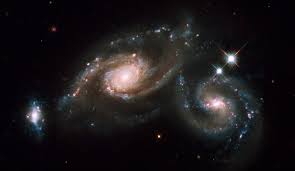
EUROPE: When two different sized galaxies smash together, the larger galaxy stops the smaller one making new stars, according to a study of more than 20,000 merging galaxies.
The research, published today, also found that when two galaxies of the same size collide, both galaxies produce stars at a much faster rate.
You might also like


Astrophysicist Luke Davies, from The University of Western Australia node of the International Centre for Radio Astronomy Research (ICRAR), says our nearest major galactic neighbour, Andromeda, is hurtling on a collision course with the Milky Way at about 400,000 kilometres per hour.
“Don’t panic yet, the two won’t smash into each other for another four billion years or so,” he says.
“But investigating such cosmic collisions lets us better understand how galaxies grow and evolve.”
Previously, astronomers thought that when two galaxies smash into each other their gas clouds—where stars are born—get churned up and seed the birth of new stars much faster than if they remained separate.
However Dr Davies’ research, using the Galaxy and Mass Assembly (GAMA) survey observed using the Anglo-Australian Telescope in regional New South Wales, suggests this idea is too simplistic.